AI Receptionist for Dental & Medical Practices: A Complete Guide
How AI receptionists answer calls, book appointments and stay HIPAA compliant for dental and medical practices - plus real costs and how to choose one.
A busy dental or medical practice typically misses a quarter to a third of its inbound calls — not through carelessness, but because whoever answers the phone is also checking in a patient and chasing an insurance verification. Every missed call is a patient who dials the next practice on the list. An AI receptionist answers all of them, at 2pm and at 2am. This guide covers how the technology works, what an AI medical receptionist or AI dental receptionist actually costs, how HIPAA compliance is handled, and how to tell a serious vendor from a demo with a nice voice.
What Is an AI Receptionist?
An AI receptionist is software that answers your practice’s phone in a natural human voice, understands what the caller wants, and completes the task — booking an appointment, answering a question about hours or insurance, or transferring an urgent call to a real person. Unlike a phone tree, there are no menus and no keypad prompts. The caller simply talks.
The distinction that matters is between an AI virtual receptionist and the technologies it replaces. An IVR or auto attendant plays a menu and routes by keypress. A traditional answering service puts a remote operator on the line who takes a message and emails it to you. An AI phone receptionist does what that operator does — but answers on the first ring, handles unlimited simultaneous calls, and writes into your scheduling software rather than an inbox you read tomorrow.
AI receptionist vs. answering service vs. human front desk
A human front-desk receptionist is unmatched at reading a distressed patient — and costs $38,000–$52,000 a year fully loaded, works 40 hours a week, and cannot answer two calls at once. A live answering service covers after-hours, but its operators do not know your practice and rarely see your schedule. An AI receptionist never sleeps, handles concurrent calls and books directly into your calendar — but hands off anything genuinely complex or emotional.
| Feature | AI Receptionist | Answering Service | Human Front Desk |
|---|---|---|---|
| Monthly cost | $100 – $500 | $250 – $900 | $3,200 – $4,300 |
| Hours covered | 24 / 7 / 365 | 24 / 7 / 365 | ~40 hrs / week |
| Simultaneous calls | Unlimited | Limited by staffing | One at a time |
| Books into your PMS / EHR | Yes — live schedule | Rarely | Yes |
| Knows your practice | Yes — configured | No — generic script | Yes |
| Handles a distressed patient | Escalates to a human | Partly | Best in class |
| Multilingual | Built in | Extra cost | Depends on the hire |
| Call transcripts & summaries | Every call | Message notes only | None |
Most practices that adopt one do not fire anyone. They stop having their front desk answer the phone during check-in, and stop paying for after-hours message-taking. The AI receptionist vs. human receptionist question is, in practice, rarely either/or — we break the three options down further in AI receptionist vs. live answering service vs. AI chatbot.
How Does an AI Receptionist Work?
An AI receptionist works in four steps: speech recognition converts the caller’s words to text, a language model interprets the intent against your practice’s rules and live schedule, the system performs the action, and text-to-speech replies in a natural voice. The loop runs in under a second, which is why a good one sounds like a conversation rather than a machine.
Each component matters. Speech recognition tuned on dental and medical vocabulary is the difference between hearing “I need a crown prep” and “I need a clown pep.” Natural language processing lets a caller say “can I move my Thursday thing to next week, mornings are better” and have it resolve correctly. Voice quality decides whether callers relax or press zero — and the usual tell is latency, not timbre. (For a deeper look at the underlying technology, see our guide to conversational AI voice agents and how they differ from chatbots.)
The call flow, step by step
The phone rings once and the agent answers with your greeting. The caller states their reason. The agent identifies them — usually by phone number, confirmed with a date of birth — checks live availability in your practice management system, offers two or three real slots, writes the appointment and sends a confirmation text. Anything outside its scope, it escalates.
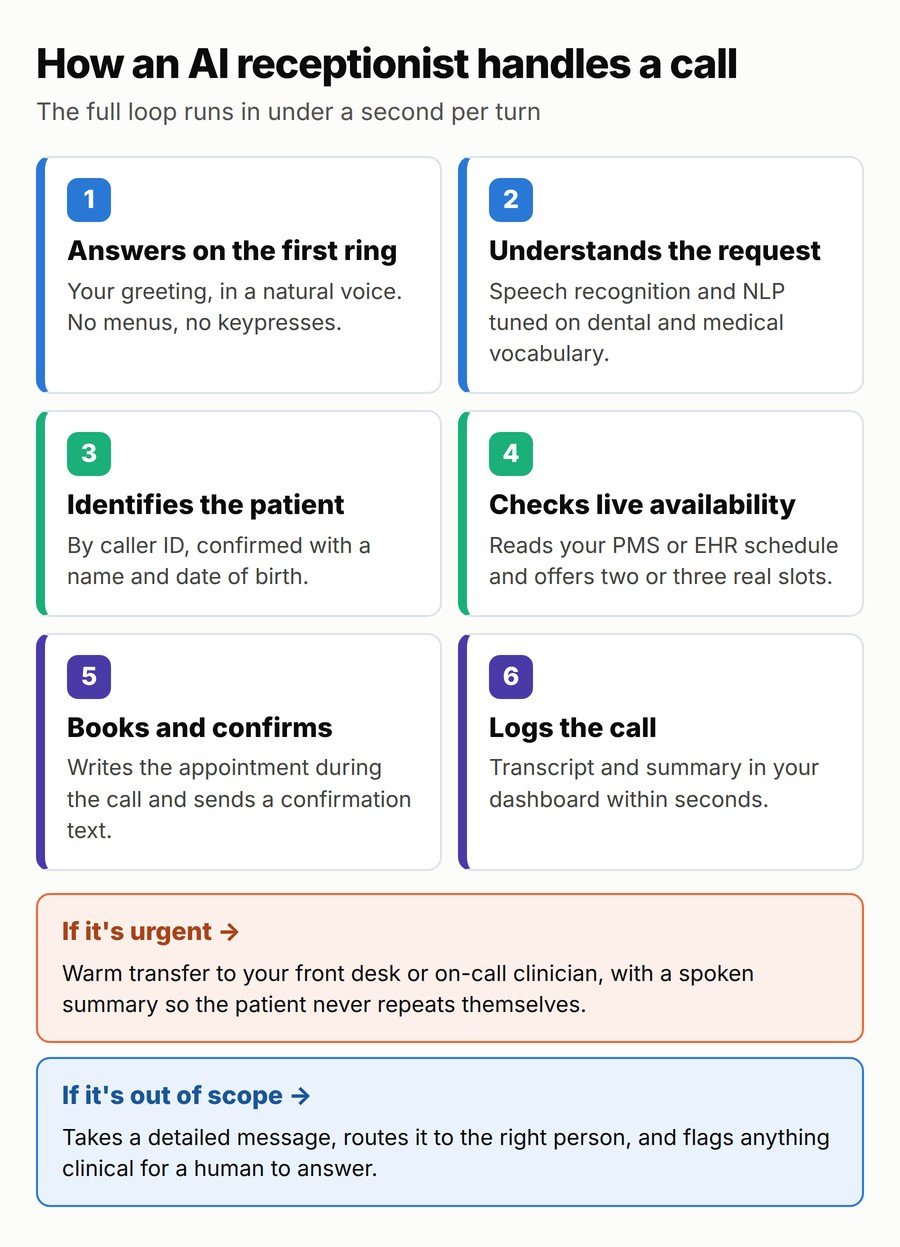
Call routing rules decide where escalations go: the front desk in hours, the on-call clinician for a triaged emergency, voicemail otherwise. After the call, a transcript and summary land in your dashboard within seconds — often the most-used feature, because practices can finally see what people are calling about.
Integrations with your PMS or EHR
This question decides whether the product is useful, because an AI receptionist that cannot see your schedule can only take messages. On the dental side the systems that matter are Dentrix, Eaglesoft, Open Dental and Denticon. Open Dental has the most accessible API; Dentrix and Eaglesoft usually need a vendor-supplied bridge on your server; Denticon, being cloud-native, suits DSOs.
None of them ship a built-in AI receptionist feature — the integration comes from the AI vendor’s side. The medical equivalents are Epic, Athenahealth, eClinicalWorks, DrChrono and NextGen, most exposing FHIR scheduling APIs. Ask the vendor to name your system and describe the integration method. “We can integrate with anything” means they have not built it yet.
Why Dental and Medical Practices Are Adopting AI Receptionists
Healthcare is the sharpest use case for a structural reason: the phone is still the dominant booking channel, and the person answering it has the most interruption-heavy job in the building. Retail can push customers to a website. A dental practice cannot — patients in pain call.
The economics follow. A single new patient is worth roughly $600–$1,200 in first-year production to a general dental practice, and more in orthodontics or implants. If an AI receptionist costing $300 a month recovers three new-patient calls that would have gone to voicemail, it has paid for itself several times over.
The after-hours gap
Roughly a third of patient calls arrive outside office hours — evenings, weekends and the 8am rush before the doors open. This is where an after-hours medical answering service has been the only option, and where AI has the clearest advantage. A 24/7 AI receptionist costs the same at midnight as at midday: no overnight staffing premium.
For dental practices the case is stronger still. A patient with a broken crown on a Saturday calls three practices; the one that answers gets them. A dental after-hours answering service that emails a message on Monday has already lost that patient.
Core Features to Look For
Every vendor’s homepage claims the same things, so evaluate on capability rather than adjectives. What separates serious AI receptionist software from a demo: live two-way calendar integration rather than message-taking, reliable human handoff, HIPAA compliance with a signed BAA, transcripts and summaries, multilingual handling, interruption handling, a robocall filter, and rules you can change yourself.
Appointment booking and rescheduling
Yes, an AI receptionist can book dental and medical appointments directly — good ones read live availability, respect appointment-type durations and provider preferences, and write the booking during the call. Rescheduling matters as much: a cancelled slot immediately offered to a waitlisted patient is revenue that would otherwise evaporate. Ask how it handles appointment types — a hygiene recall and a 90-minute crown prep are not interchangeable blocks.
Call transfer, triage and escalation
An AI receptionist should transfer calls, and the rules should be yours to set. Dental practices typically escalate trauma, swelling, uncontrolled bleeding or severe pain; medical practices escalate on a symptom list plus anything a caller flags as urgent. Insist on a warm transfer — the agent stays on the line and passes a spoken summary to your staff member — rather than a cold transfer that makes the patient explain everything twice.
Multilingual and bilingual support
Modern AI receptionists handle multiple languages well, and for many practices this single feature most changes patient access. Spanish is standard; Mandarin, Vietnamese, Tagalog, Arabic and Portuguese are widely available. The agent detects the caller’s language in the first sentence and continues in it — no menu, no “press 2 for Spanish.” Verify non-English voice quality matches the English voice.
HIPAA Compliance and Patient Data
An AI receptionist can be HIPAA compliant, but it is not compliant by default — compliance is a property of the vendor’s contract and configuration, not the technology. The non-negotiable requirement is a signed Business Associate Agreement. A vendor that will not sign a BAA cannot lawfully handle protected health information, however good the product is.
Beyond the BAA, check four things. Encryption: audio, transcripts and stored data encrypted in transit and at rest. Data residency and retention: where recordings live and how long they are kept. Model training — the most overlooked one — your call data must contractually never train models, including at subprocessors. Access controls and audit logs, so you can show who listened to what.
The same applies to dental practices; dental PHI is PHI. If the vendor uses a third-party speech-to-text or language model provider, that provider is also touching PHI and needs covering under a BAA chain. A HIPAA compliant medical answering service, AI or human, can produce this paperwork on request.
AI Receptionist Cost: What Practices Actually Pay
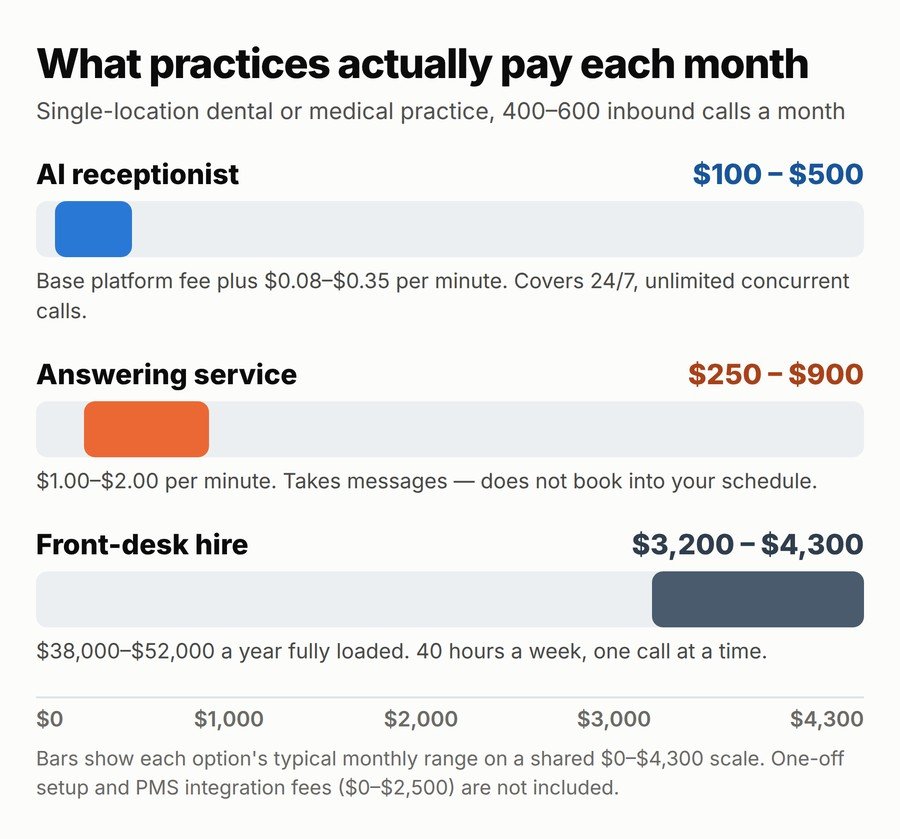
Most AI receptionists for dental and medical practices cost $100–$500 per month for a single location: a base platform fee plus per-minute usage at $0.08–$0.35 a minute. A practice handling 400–600 inbound calls a month typically lands around $250–$400 all-in.
Three models dominate. Flat monthly ($199–$499 for a defined call volume) is easiest to budget. Per-minute is cheapest at low volume, unpredictable at high. Per-location enterprise pricing for DSOs runs $80–$200 per site. Watch for setup and integration fees of $0–$2,500.
For comparison, a traditional medical answering service costs $1.00–$2.00 per minute, or $250–$900 a month for equivalent coverage — and it does not book appointments. Free AI receptionist tools are trial tiers or generic voice bots with no healthcare integrations and no BAA. For a practice handling PHI, free is not a viable category.
AI receptionist vs. hiring front-desk staff
A full-time front-desk receptionist costs roughly $38,000–$52,000 a year once payroll taxes, benefits, paid leave and training are included — call it $3,500 a month for 40 hours a week of coverage from one person who handles one call at a time.
An AI receptionist at $300 a month covers 168 hours a week with unlimited concurrent calls and no turnover. But replacement is the wrong frame: the AI absorbs the 60–70% of calls that are routine — hours, directions, “am I due for a cleaning”, simple rebooking — so your staff can focus on the patients in front of them.
AI Receptionists for Dental Practices
Dental practices have requirements generic products handle badly. An AI dental receptionist needs to understand dental vocabulary — prophy, perio maintenance, crown seat, quad scaling — and book against appointment types with very different durations, provider assignments and operatory requirements. A system that treats every appointment as a 30-minute block will not survive a real hygiene schedule.
Test the dental-specific capabilities: recall and reactivation calls, insurance questions answered against your accepted-plan list, triage that distinguishes a lost filling from facial swelling, and waitlist filling on cancellations. Dental-native vendors such as Dentina, Weave and Viva win on PMS integration depth; horizontal platforms win on voice quality and price.
One test before you buy: call the vendor’s demo line and try to break it. Mumble. Interrupt. Ask for a Saturday when they are closed. How it handles messy calls predicts how it will handle yours.
Multi-location practices and DSOs
For a DSO the calculation changes entirely. Instead of one front desk there are twenty, each with its own coverage costs and unmeasured missed-call rate. An AI receptionist for DSOs is centralised infrastructure: one system, location-aware routing, consistent scripting, and one dashboard showing call volume, answer rate and booking conversion by location.
That reporting is often the real purchase. Most DSOs cannot answer “how many patient calls did we miss last month across the group?” A DSO AI receptionist answers it on day one. Look for per-location configuration under a group template, SSO, and pricing that scales down per site.
AI Receptionists for Medical Practices and Clinics
An AI medical receptionist faces a harder compliance bar and a wider range of call types than its dental equivalent. Medical front desks field refill requests, referral questions, lab result enquiries and insurance verification — and the boundary between administrative and clinical is one an AI must never cross. A well-configured AI receptionist for medical office workflows takes the refill request and routes it; it does not advise on the medication.
The capabilities that matter for clinics: triage rules written by your clinical staff rather than the vendor, patient intake that captures demographics and insurance before the visit, insurance verification against your accepted-carrier list, and a hard-coded protocol directing anyone describing a life-threatening symptom to call 911 immediately.
Specialty practices see the strongest results. AI receptionists for therapy clinics and mental health practices are a notably good fit — high call volume, high no-show cost, and patients who often prefer booking without explaining themselves. Physical therapy, dermatology and optometry show similar patterns.
Limitations: What an AI Receptionist Still Can’t Do
No, AI will not replace receptionists — and any vendor telling you otherwise is selling badly. There are things these systems handle poorly, and knowing them before you deploy separates a successful rollout from an embarrassing one.
They struggle with distressed callers, where an ear for tone matters more than accurate transcription. They handle multi-part enquiries — a billing dispute that is also an insurance question and a reschedule — less gracefully than a competent human. They fail on heavy accents and poor lines more often than a person would. And they cannot judge exceptions: the long-standing patient who should be squeezed in today is invisible to a rules engine.
The model that works is a split: AI handles routine and after-hours volume, humans handle exceptions and anything emotional. Practices attempting to replace a dental receptionist with AI entirely usually reverse the decision within a quarter. Practices using it to stop losing calls keep it.
How to Choose and Set Up an AI Receptionist
Choosing well comes down to five questions, in order of importance. One: does it integrate with your specific PMS or EHR, by name, today? Two: will they sign a BAA and show their subprocessor list? Three: how does it sound on a difficult call you place yourself? Four: what is the fully loaded monthly cost at your real call volume, including setup? Five: can you change the greeting, hours and escalation rules yourself?
Setup takes one to three weeks: connect the PMS or EHR and verify the calendar reads correctly, script the greeting, FAQs and escalation rules, then run a testing period where the AI answers only overflow or after-hours calls while you review every transcript. Forward rather than port your number initially, so reverting takes minutes. And brief your front-desk team properly — staff who think a system is there to replace them will find reasons it does not work.
Frequently Asked Questions
How much does an AI receptionist cost?
Most practices pay $100–$500 per month. Pricing is typically a base platform fee plus $0.08–$0.35 per minute of call time. A single-location practice with 400–600 monthly calls usually lands around $250–$400 all-in. Setup and PMS integration fees range from $0 to $2,500 depending on the system.
Is an AI receptionist HIPAA compliant?
It can be, but only if the vendor signs a Business Associate Agreement, encrypts data in transit and at rest, and contractually agrees not to use your call data for model training. Compliance is a property of the vendor’s contract and configuration, not of the technology. Always ask for the subprocessor list.
Can an AI receptionist book dental appointments?
Yes. Systems integrated with Dentrix, Eaglesoft, Open Dental or Denticon read live availability, respect appointment-type durations and provider assignments, and write the booking into your schedule during the call. Confirm the vendor supports your specific practice management system by name before signing.
Will AI replace receptionists?
No. AI reliably handles routine calls — hours, directions, simple booking and rescheduling, after-hours coverage — which is roughly 60–70% of volume. It does not handle distressed patients, complex billing disputes or judgment calls about exceptions. Most practices redeploy front-desk staff rather than reduce them.
Can an AI receptionist transfer calls?
Yes, and you set the rules. Insist on a warm transfer, where the agent stays on the line and gives your staff member a spoken summary before dropping off, so the patient does not repeat themselves. Define a fallback chain for escalations nobody picks up.
Do Dentrix, Eaglesoft or Open Dental have a built-in AI receptionist?
None ship one natively — the AI receptionist is a separate product that integrates with them. Open Dental is easiest thanks to its open API; Dentrix and Eaglesoft usually need a vendor-supplied bridge; Denticon suits multi-location DSO deployments.
Is an AI receptionist worth it for a small practice?
Usually yes, and small practices see the fastest payback because they have the least phone redundancy. One recovered new patient a month typically covers the cost several times over. The exception is very low volume — under roughly 100 calls a month the math gets thinner.
The Bottom Line
An AI receptionist for dental and medical practices is no longer an experiment. Voice quality is good enough, practice management integrations are real, and pricing sits well below both a front-desk hire and a legacy answering service. The practices getting the most from it are the ones who worked out how many calls they were losing, and stopped.
Start by measuring your own missed-call rate for two weeks. If more than one in five goes unanswered, the case makes itself. Shortlist on PMS integration and BAA first, voice quality second, price third — and test every candidate on a difficult call before signing.
#24/7 CALL ANSWERING#AI AUTOMATION#AI DENTAL RECEPTIONIST#AI MEDICAL RECEPTIONIST#AI RECEPTIONIST#APPOINTMENT BOOKING#DENTAL PRACTICE#DSO#HIPAA COMPLIANCE#LIVE ANSWERING SERVICE#MEDICAL PRACTICE#VOICE AI
Let’s make
your next move.
LET’S TALK
Bring your ambition.
We’ll bring a different perspective.