Website Security Response Plan: Protect Campaigns and Client Trust
A marketing operations playbook for security alerts: decide what happens to traffic, trace lead delivery, communicate confirmed facts and verify recovery before reopening campaigns.
Marketing operations · Updated 22 October 2026 · By the Scalematix editorial team
Your advertising can keep buying clicks while the destination stops doing its job. The landing page might still load. The form might even display a success message. The failure can sit one step later, where an enquiry should enter the CRM or a booking should reach the business.
A website security response plan therefore belongs in marketing operations. Technical specialists own the security work. The marketing team owns decisions about the traffic it sends, the claims it makes to clients and the evidence it needs before restoring normal activity.
The urgent PHP alert of October 2026 is a useful test of that division. This article focuses on protecting campaigns and customer journeys during a security response, rather than giving server patching instructions.
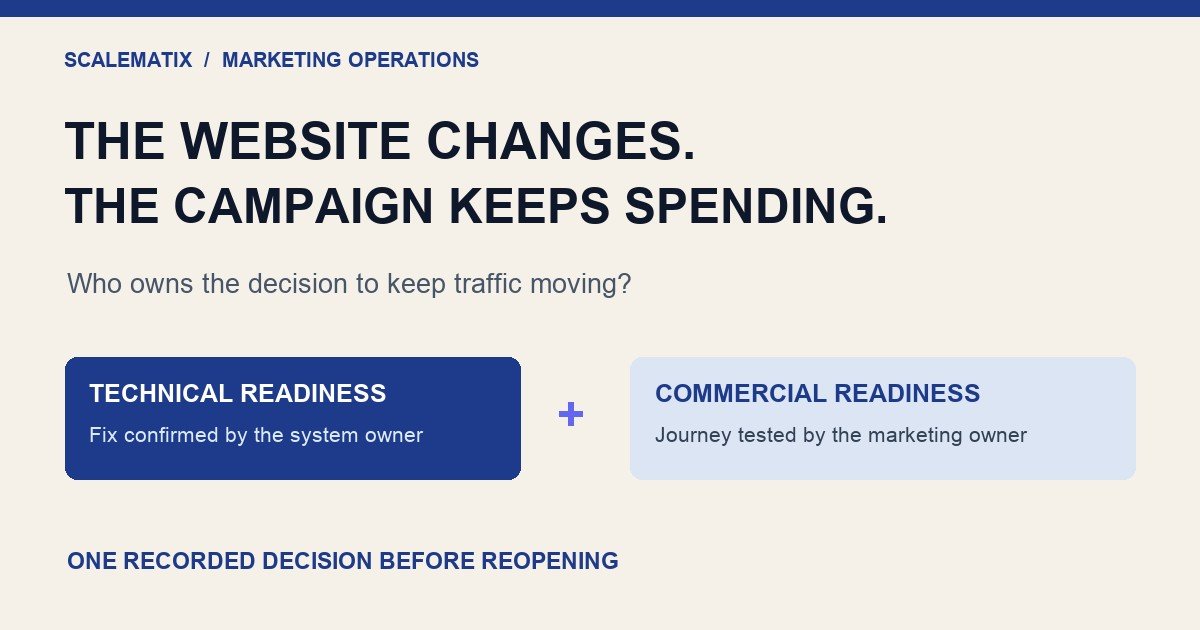
The operating principle: Give technical remediation and commercial continuity separate owners, then join their evidence before reopening an affected journey. A patched server and a working customer journey need separate confirmation.
What triggered the PHP security response
The PHP project published fixes on 21 October 2026 for CVE-2026-109618 and CVE-2026-109619, two critical vulnerabilities that can allow unauthenticated remote code execution. Its official advisory is the source for affected deployments and remediation. This is relevant to marketing teams whose websites or connected applications use PHP.
An alert does not prove a client’s website has been compromised. Treat it as a reason to establish scope and request evidence. Avoid sending every client an alarmist breach announcement or assuming the hosting provider has already handled every application.
At Scalematix, we would organize the response around a more useful question: which customer journeys are affected, and what decisions are waiting for verified information?
Build a customer-journey map before changing campaigns
A domain list tells you where a website lives. A journey map tells you what stops working when part of the system changes.
Take a lead-generation campaign. The advert points to a landing page. Its form creates a lead in the CRM. A routing rule assigns the lead and sends a notification. An appointment link then takes the prospect to a booking service. Several teams may own that sequence.
Mark which steps depend on the affected PHP environment. A separately hosted booking service may still function while the main site’s form does not. A WordPress landing page may load from cache while its submission endpoint fails. These are scenarios to test, rather than conclusions to assume.
| Journey step | Evidence to collect | Decision it supports |
|---|---|---|
| Advert to landing page | Actual destination, redirects and usable page | Whether traffic can reach the promised experience |
| Form or checkout | A completed synthetic transaction | Whether the conversion action functions |
| CRM or order system | The corresponding record and identifier | Whether the business received the action |
| Follow-up | Expected assignment and notification | Whether someone can act on the enquiry |
| Measurement | Expected event and reconciliation | Whether reporting represents what happened |
This is why marketing automation needs explicit ownership at the handoffs. A test that stops at a green confirmation message can miss the commercial failure.
Give four decisions a named owner
During a response, “the agency is handling it” is too broad to guide action. Assign decision rights before the support conversation becomes a long chain of copied messages.
- Technical remediation: the host, internal engineering lead or contracted technical operator establishes exposure and confirms the deployed fix.
- Campaign control: the authorized marketing lead decides whether affected campaigns remain active, pause or use an approved alternative.
- Client communication: one person maintains the account’s factual status and next update.
- Return to normal activity: a named approver checks technical confirmation alongside a tested customer journey.
One person can hold more than one role, but each decision needs an explicit owner. Access matters too. The person approving a pause may not have access to every advertising account; identify the executor before the decision is urgent.
A white-label delivery partner should know which parts of this workflow sit within the existing brief. Do not let a subcontractor make claims about a client’s infrastructure without evidence from the person who operates it.
Decide whether to pause paid traffic with a destination test
Do not pause every campaign just because a security bulletin arrived. Do not keep spending solely because the homepage loads. Base the decision on the affected journey and the technical team’s assessment.
| Verified situation | Marketing response to consider | Required owner |
|---|---|---|
| Destination disabled, broken or considered unsafe | Pause affected traffic promptly under agreed authority | Campaign lead with technical input |
| Scope unclear; technical assessment pending | Request an urgent assessment; record the interim traffic decision and review time | Account owner and technical lead |
| Patch confirmed; conversion journey untested | Hold reopening of a previously paused journey until its functional test passes | Release approver |
| Destination fixed; tracking has an unresolved gap | Use a documented temporary measurement plan or hold activity, depending on risk and objectives | Marketing and analytics owners |
| Technical and journey checks complete | Resume approved activity and observe the result | Named campaign approver |
The matrix is a recommended operating framework, not a platform rule. Google Ads destination requirements separately require functional, accessible destinations. Do not assume a maintenance page or a redirect will automatically satisfy those requirements.
If you propose an alternative landing page, verify the actual route and its measurement. Keep the destination consistent with the advert and the promised service. Moving visitors to a hastily built page can introduce another broken handoff.
Describe spend exposure without inventing lost revenue
Suppose an affected campaign spends $600 per day. Using a simplified, evenly distributed spend assumption, a six-hour interruption represents $150 of potential spend exposure: $600 ÷ 24 × 6. That is an illustration, not a benchmark or a statement about how a particular advertising platform paces spend.
Use actual account data once it is available. Money spent while a destination is unavailable is not automatically equal to lost revenue. Estimating the latter needs evidence about conversions and customer value that a security alert does not provide.
That distinction belongs in performance marketing reporting. Report what happened to spend and enquiries before attaching a revenue claim.
Send a client update that separates facts from pending checks
The first useful update does not need to contain a technical root-cause essay. It needs to explain the account’s status and the decision being made.
Build the message from five fields:
- Confirmed information: the relevant advisory and the systems your technical owner has identified.
- Current impact: what is known about availability or customer journeys.
- Action underway: the owner of the technical work and the owner of any campaign adjustment.
- Pending evidence: the checks required before the status changes.
- Next update: a specific agreed time, even if the investigation may still be open.
If scope is still unknown, say that it is being checked. If a patch is installed but testing is pending, say that too. “Everything is secure” is a much larger claim than a routine patch confirmation supports.
Do not promise a completion time that the technical owner has not accepted. A useful update time is a commitment to communicate; it does not have to be a promise that remediation will be complete.
Keep sensitive technical evidence in the agreed private workspace. Client updates rarely need server identifiers, personal records or diagnostic output copied into an email thread.
Three different accounts need different continuity plans
These hypothetical examples show why one blanket campaign decision is often unhelpful. They are not client case studies or claims of measured results.
A service business with a working page and a broken form
The landing page remains available after maintenance. A test submission displays success, but no lead appears in the CRM. The correct next action is to investigate the handoff and decide what to do with traffic to that journey.
If an approved, tested phone enquiry route exists, the account owner can assess whether it is suitable as a temporary alternative. Do not count a phone click as a completed qualified enquiry. Keep the fallback’s reporting separate until its outcomes can be reconciled.
An ecommerce brand with a functioning catalogue
Product pages work, but checkout fails after a runtime change. A browse-only uptime check would miss the interruption at the point where the customer attempts to buy.
Map which campaigns land on that storefront. Use approved sandbox or test-mode transactions to check the order journey. Agree who can pause affected activity, and resume only after both the technical change and purchase path have been verified.
A SaaS team with separate marketing and product systems
The main marketing website uses WordPress, while the application and billing system run elsewhere. That does not establish which system is affected or unaffected. Ask each owner to confirm the actual dependency.
A live product does not prove that the demo-request flow works. Equally, a maintenance event on the marketing site does not automatically require disabling every existing product customer’s access. Separate the journeys so that each decision has a proportionate scope.
Protect measurement before declaring recovery
A technical change can leave the visible customer journey intact while disrupting its measurement. Review the forms and events most closely connected to the affected environment.
- Check that a test action produces the expected CRM or order record.
- Confirm the analytics event represents the completed action rather than only a button press.
- Look for duplicate submissions or duplicate events after retries.
- Document any gap in attribution or event collection.
- Verify that the expected follow-up reaches the responsible team.
Use a clearly labeled synthetic test and keep it out of qualified-lead totals. Where a real payment is unnecessary, use the approved test mode. For sensitive enquiries, use the organization’s established testing and privacy procedures rather than entering real customer information casually.
Reconcile systems at the end of the affected period. For example, if the form system logged 12 submissions and the CRM received 9, those figures establish a discrepancy of 3 records to investigate. They do not prove the runtime update caused it. Check duplicates, filters and delivery status before assigning a cause.
This is a reason to maintain a shared event timeline. Record the patch window, campaign decisions and tracking changes in the same time zone. Otherwise, a daily report can hide that an advertising adjustment and a form failure happened several hours apart.
Use a reopening checklist with two approvals
We recommend two evidence-based approvals: technical readiness and commercial readiness. They can be completed by a small team; the purpose is to avoid conflating different tests.
Technical readiness comes from the person responsible for the environment. Their confirmation identifies the relevant fix and the running deployment. If there is evidence of compromise, it also identifies the separate incident-response decision about safe restoration.
Commercial readiness comes from the person responsible for the customer journey. Their test establishes that the destination works, the business receives the action and the agreed measurement is available or its limitation is documented.
When both are present, the authorized campaign owner can reopen the affected activity. Check performance afterward against the account’s normal volume and the period affected. Avoid attributing a short-term change to the incident without enough data.
“Traffic resumed” should be the result of a recorded decision, with the evidence attached.
Make website security response part of the operating agreement
A marketing retainer does not automatically make the agency the client’s security provider. The agreement should explain who receives urgent advisories and who operates the infrastructure. WordPress’s hardening handbook also highlights the need to understand the boundary between hosting and application responsibilities.
Add a short response appendix to the account’s working documentation:
- The technical and commercial contacts, including a backup contact.
- The approval route for pausing spend and changing destinations.
- The systems covered by the agency’s brief and those operated elsewhere.
- The evidence required to reopen a journey.
- The location of the incident timeline and the client-update record.
- The route for work outside the agreed scope.
Agree the process before relying on it. Do not quietly expand a routine content or advertising contract into an incident-response commitment that the delivery team cannot meet.
After the event, review the handoffs that consumed time. If the team struggled to locate a hosting owner, fix the contact record. If nobody knew which CRM workflow followed the form, document it. These are concrete improvements to the growth system, rather than another broad promise to “communicate better.”
Questions marketing teams should resolve
Should we stop every campaign after a PHP alert?
No blanket decision fits every account. Establish scope with the technical owner, identify affected destinations and record the authorized traffic decision. A destination known to be unsafe or nonfunctional needs prompt action.
Can we tell clients they have been hacked?
An advisory alone does not establish that. Communicate confirmed findings and identify what remains under investigation. Keep incident conclusions with the people responsible for examining the evidence.
What if hosting is outside the agency’s contract?
Ask the client to connect the responsible operator. The agency can still manage decisions within its existing authority, such as checking its campaign destinations and documenting the status of lead delivery.
When is it appropriate to resume paused advertising?
When the authorized approver has the required technical confirmation and a tested customer journey. Record any remaining measurement limitation and the plan to resolve it.
Make the next decision easier to verify
Begin with your highest-priority conversion journey. Name its technical operator and campaign decision-maker. Test it from the actual destination through to the system where the business acts on the result.
A security bulletin creates urgency. A clear operating process turns that urgency into accountable decisions. Talk to Scalematix about the gaps between your campaigns, website and follow-up systems if those handoffs are still difficult to trace.
Prepared by the Scalematix editorial team. Sources checked on 22 October 2026. Scenarios and calculations are illustrative. Technical remediation remains with the operator responsible for each environment.
#CAMPAIGN CONTINUITY#CLIENT COMMUNICATION#CONVERSION TRACKING#MARKETING OPERATIONS#PAID MEDIA#WEBSITE SECURITY RESPONSE PLAN
Let’s make
your next move.
LET’S TALK
Bring your ambition.
We’ll bring a different perspective.