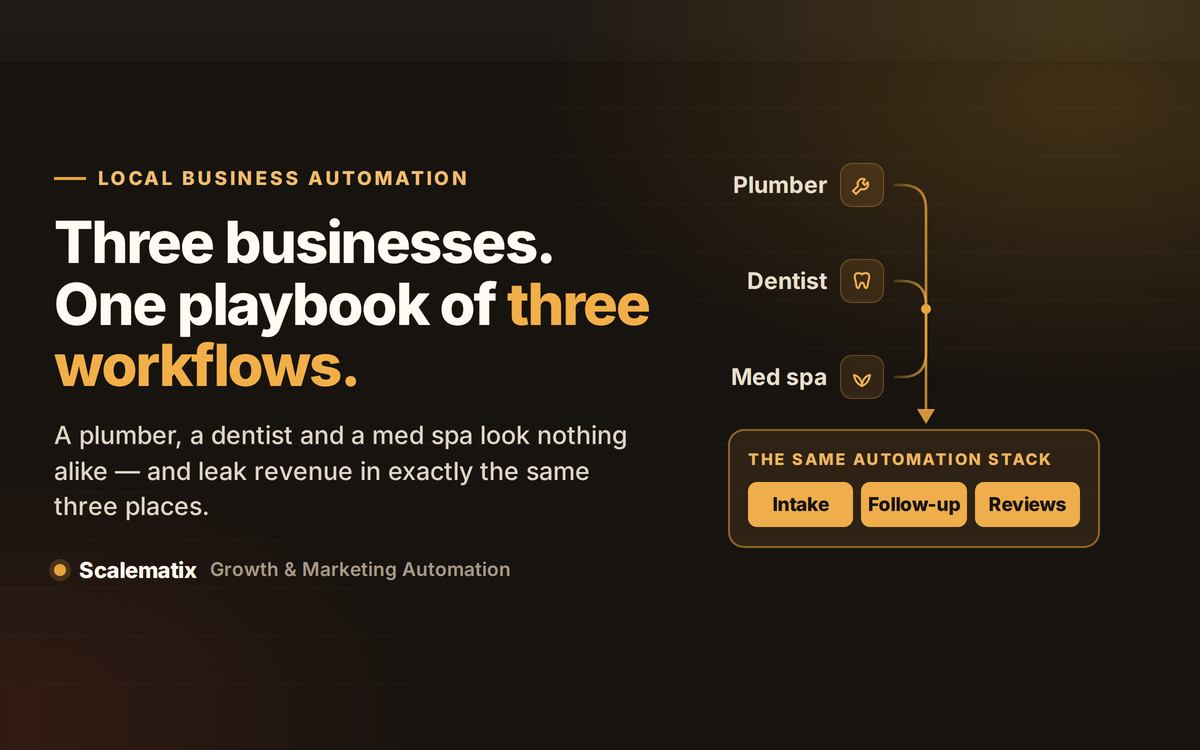
A plumber, a dentist, and a med spa walk into an automation project. They walk out with the same three workflows.
That is not a setup for a punchline — it is the most reliable pattern in local business automation. Almost every local service business leaks revenue in the same three places: intake (inbound enquiries nobody answers fast enough), follow-up (interested people who were never chased), and review requests (happy customers who were never asked). Fix those three, in that order, and you have captured most of what marketing automation is actually worth to a local business. Everything else — the industry software, the compliance layer, the offer — is configuration sitting on top of the same engine.
This matters commercially, and not just operationally. If the underlying system is identical across industries, you stop selling bespoke builds and start selling one repeatable product with three settings files. That is the difference between an agency that scales and an agency that reinvents itself with every client.
Key takeaways
- Three workflows cover most of the opportunity: intake, follow-up, and review requests. Industry changes the wording and the timing, not the architecture.
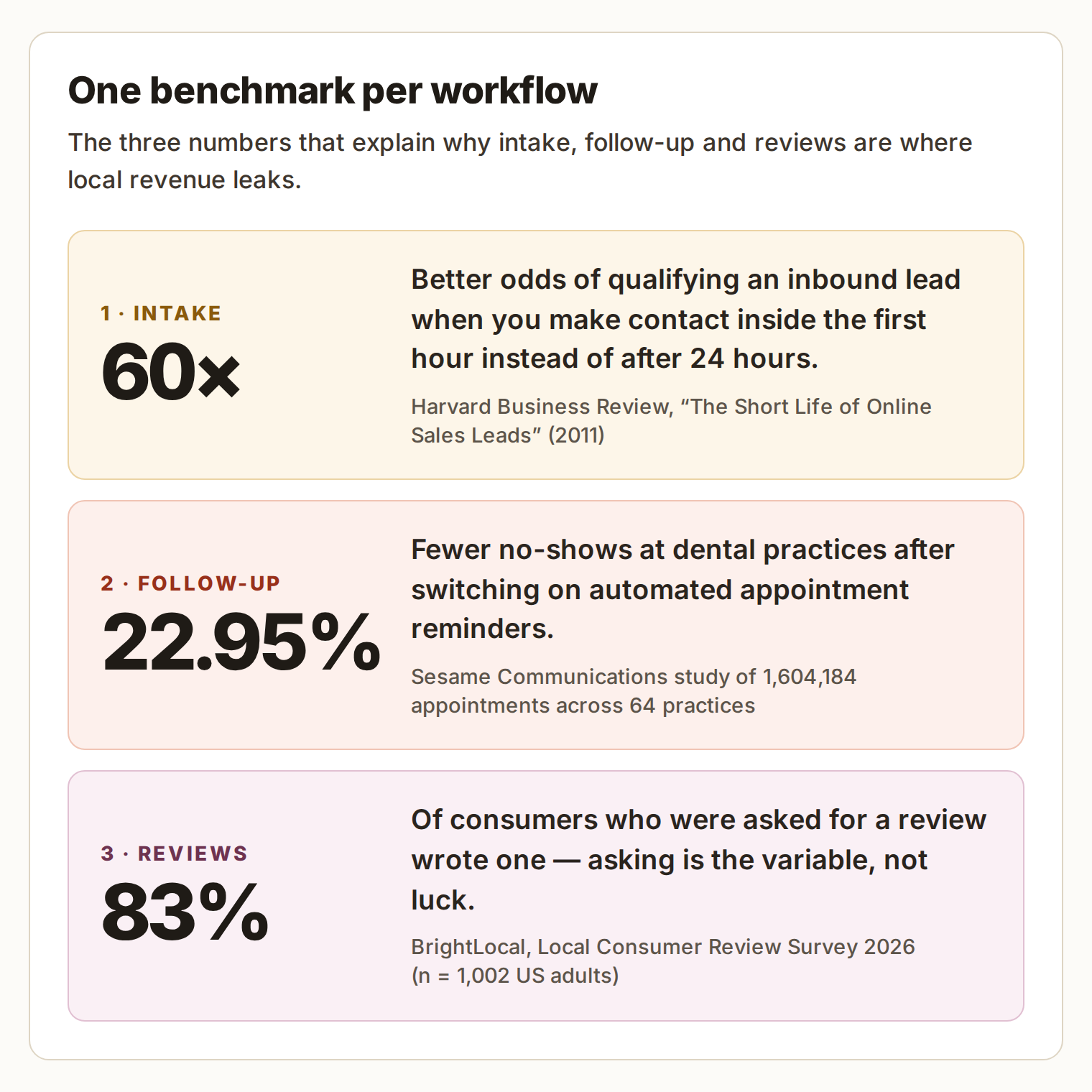
- Speed is the whole game at intake. Firms that contacted a lead within the first hour were roughly 60 times more likely to qualify it than those that waited a day, according to Harvard Business Review research.
- Follow-up is where the margin hides. A study of more than 1.6 million dental appointments found automated reminders cut no-shows by 22.95%.
- Reviews are a request problem, not a luck problem. BrightLocal’s 2026 survey found 83% of consumers who were asked for a review wrote one.
- Build once, configure three times. The shared engine is the product; the industry layer is the setup fee.
Why three unrelated industries have identical bottlenecks
A burst pipe, a cracked molar, and a first botox consultation have nothing in common clinically. Commercially they are the same transaction: a local person with a problem, a short window of intent, a phone call or a form, a booked slot, a completed service, and a public opinion left behind.
Because the transaction shape is the same, the failure points are the same. The business is busy delivering the service, so nobody is free to answer the phone. The person who did not book today is not chased tomorrow. The customer who left delighted is never asked to say so where it counts. Three different industries, three identical holes in the bucket.
The vocabulary changes by industry, which is what makes the pattern hard to see from the inside. A plumber says “estimate,” a dentist says “treatment plan,” a med spa says “consultation.” All three mean the same thing: a qualified person who has not yet paid.
| The underlying job | Plumber calls it | Dentist calls it | Med spa calls it |
|---|---|---|---|
| Inbound enquiry | Service call | New patient enquiry | Consult request |
| Qualified but unpaid | Estimate | Treatment plan | Consultation |
| Booked but unattended | No-access call | No-show | Missed appointment |
| Dormant past customer | Annual service due | Recall / hygiene due | Rebooking window |
| Proof for the next buyer | Google review | Google review | Google review |
Workflow 1 — Intake: answer before your competitor does
Intake automation captures every inbound contact — call, form, chat, or ad click — qualifies it with a few structured questions, and puts a booking option in front of the person within minutes rather than hours. It is the highest-value of the three workflows because it is the only one that operates while intent is still hot.
The evidence on response speed is unusually blunt. In the study behind “The Short Life of Online Sales Leads,” published in Harvard Business Review in 2011, Oldroyd, McElheran and Elkington found that firms attempting contact within an hour of an enquiry were nearly seven times more likely to have a meaningful conversation with a decision maker than those that waited an hour longer — and more than 60 times more likely than those that waited a day or more.
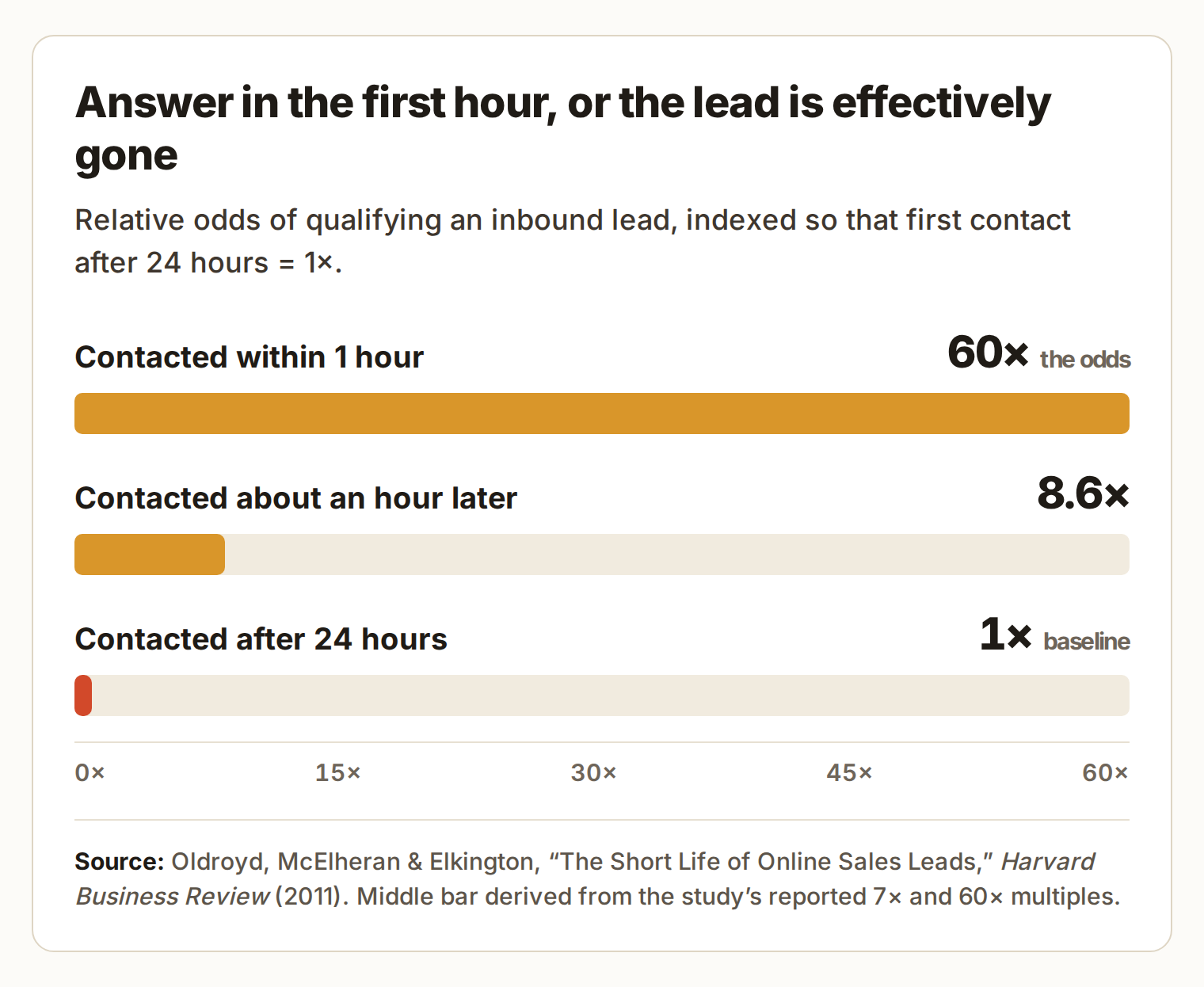
For a local business the practical version is even starker, because the buyer is usually contacting three or four providers at once. The plumber who answers first wins the job before the second plumber has listened to the voicemail. Speed is not an efficiency gain here; it is the entire competitive position.
What the intake workflow actually does
- Catch the miss. Any unanswered call triggers an immediate text back: “Sorry we missed you — this is [Business]. What do you need help with?” The conversation continues over SMS, which the business can answer between jobs or between patients.
- Qualify with two or three questions. Enough to route, not enough to interrogate. Emergency or scheduled? Insurance or self-pay? Which treatment?
- Create the record. Every contact lands in the CRM with source, timestamp, and answers attached — so nothing depends on a sticky note.
- Offer the slot. A booking link, live availability, or a callback window. The goal is to end the first exchange with a time on the calendar.
- Route the exception. Genuine emergencies, high-value enquiries and anything the automation cannot classify go straight to a human with context already attached.
Voice adds a layer on top of this for businesses with real call volume. An AI receptionist can answer, qualify and book without a human picking up at all, which is the difference between capturing 9am-to-5pm demand and capturing all of it.
How intake differs across the three industries
| Plumber | Dentist | Med spa | |
|---|---|---|---|
| Response window | Minutes — the job goes to whoever answers | Same business day | Same business day |
| Qualifying questions | Emergency or scheduled? Property type? Location? | New or existing patient? Insurance? Pain now? | Which treatment? Budget range? Previous provider? |
| Desired first outcome | Dispatch slot | Appointment | Booked consultation |
| Constraint to respect | Technician availability | Health-information privacy rules | Medical claims and advertising rules |
| Highest-leverage fix | Missed-call text-back | After-hours call answering | Instant reply to social and ad enquiries |
Workflow 2 — Follow-up: the money is in the second, third and fourth touch
Follow-up automation chases the people who did not book, confirms the people who did, and wakes up the people who have gone quiet. It is the least glamorous of the three workflows and reliably the most profitable, because every contact it works on has already been paid for once.
Local businesses tend to treat follow-up as a personality trait — some owners are diligent, most are busy. Automation turns it into a property of the system. The quote sent on Tuesday gets a nudge on Thursday whether or not anyone remembered. The appointment booked three weeks out gets confirmed twice. The patient who has not been seen in fourteen months hears from the practice in month fifteen.
The no-show case has the cleanest evidence. A Sesame Communications analysis of 1,604,184 appointments across 64 dental practices found no-shows fell by 22.95% after automated reminders were switched on, and that the improvement held across the full 36-month period studied. More recently, MGMA’s August 2025 poll of medical group leaders found 73% of practices reported no-show rates that were flat or improving year over year, with respondents crediting frequent digital reminders, easy self-service rescheduling, and automated outreach.
The three sequences every local business needs
- The confirmation sequence. Booked but not yet attended. Confirmation on booking, a reminder 48 hours out, a reminder the morning of, and a one-tap reschedule link in every message. The reschedule link matters more than the reminder — most no-shows are people who could not face admitting they wanted a different time.
- The unconverted sequence. Quoted, consulted, or diagnosed but not booked. Three to five touches over two weeks, each one adding something — a financing option, a photo of similar work, an answer to the objection the person actually raised. Then stop and move the contact to the long list.
- The reactivation sequence. Past customers outside their normal cycle. Annual boiler service, six-month hygiene recall, treatment top-up window. This is the cheapest revenue any local business will ever book, and almost nobody runs it consistently.
Two rules keep these sequences from becoming spam. First, every sequence exits the moment the person replies or books — nothing is worse than a nudge that arrives after the customer already said yes. Second, every message contains one clear action. A follow-up that asks the recipient to “let us know your thoughts” is a follow-up that gets ignored.
| Sequence | Plumber trigger | Dentist trigger | Med spa trigger |
|---|---|---|---|
| Confirmation | Job scheduled more than 24h out | Appointment booked | Consultation or treatment booked |
| Unconverted | Estimate sent, not accepted in 48h | Treatment plan presented, not scheduled | Consultation attended, treatment not booked |
| Reactivation | 12 months since last service | 6-month recall window passed | Treatment interval elapsed |
| Typical touches | 3 over 10 days | 4 over 3 weeks | 4 over 2 weeks |
| Best-performing channel | SMS | SMS plus email | SMS plus social DM |
Workflow 3 — Review requests: turn finished jobs into future customers
Review automation asks every satisfied customer for a review at the moment they are most likely to leave one, routes them to the platform that matters for that business, and flags unhappy responses to a human before they become public.
Most local businesses treat reviews as weather — something that happens to them. BrightLocal’s Local Consumer Review Survey 2026, based on 1,002 US adults, shows how far that is from the truth: 78% of consumers had been asked for a review in the past year, and 83% of those asked wrote one. The single biggest determinant of a business’s review volume is whether it asks.
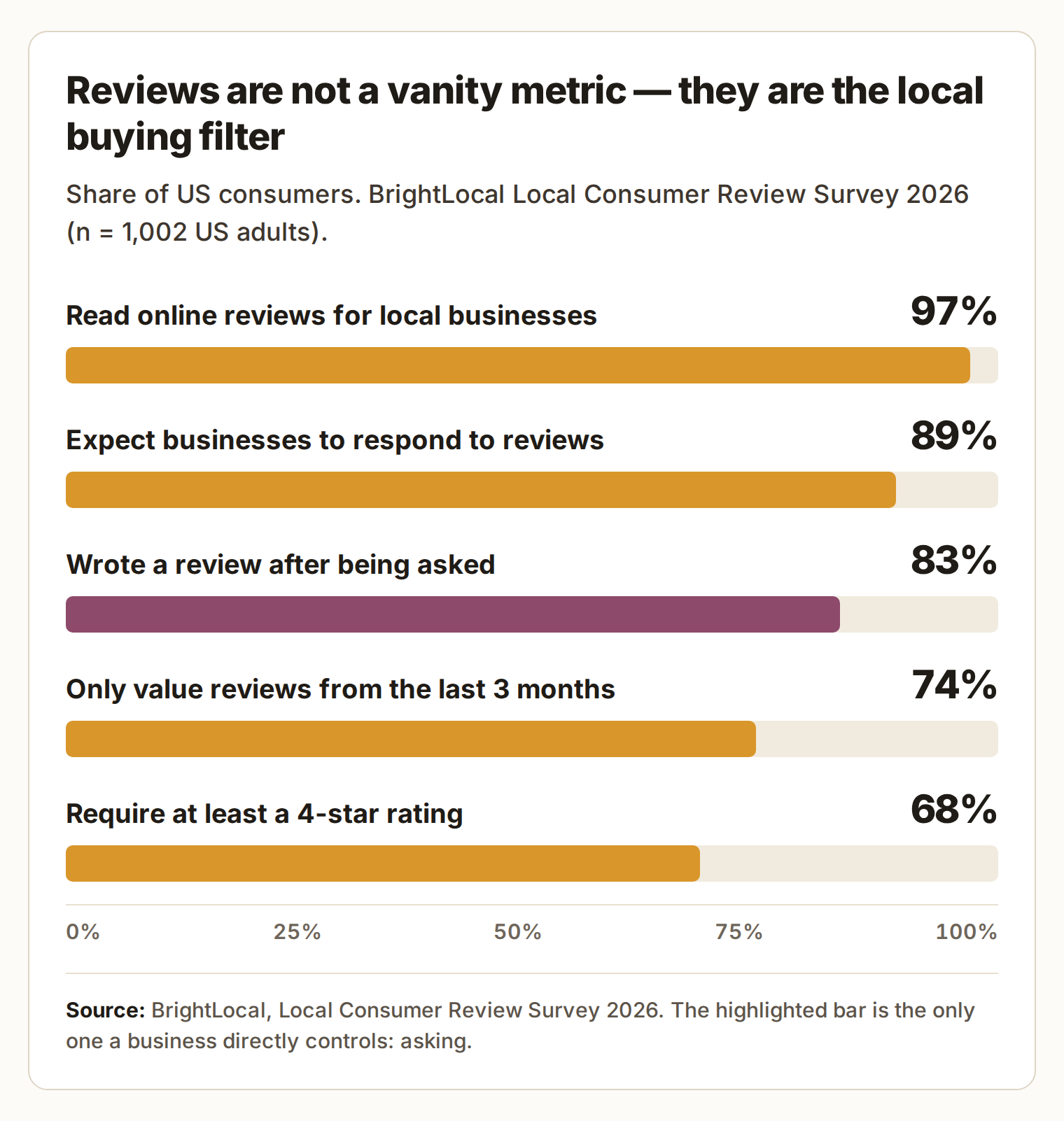
The recency finding is the one that changes the workflow design. When 74% of consumers only care about reviews written in the last three months, a business with 400 reviews and nothing since spring is competing as though it had none. Review generation cannot be a push that happens when the rating dips. It has to run on every completed job, forever.
Four rules that make review automation work
- Ask at the peak, not at the invoice. The plumber asks when the leak stops, not when the payment clears. The dentist asks after the appointment, not after the billing statement. The med spa waits until results are visible — often a week or two post-treatment.
- Ask everyone, not the ones you like. Selective asking produces a rating that drifts from reality and a review profile that reads as curated. Send to every completed job and let the average settle honestly.
- Catch the unhappy before the public does. A single satisfaction question ahead of the review link routes low scores to the owner instead of to Google. This is service recovery, not review gating — the customer must always still be able to review publicly.
- Automate the reply, not just the ask. 89% of consumers expect a response to reviews, and half are put off by obviously templated ones. Draft replies automatically, have a human approve them, and never send the same sentence twice.
One system, three configurations
Once the three workflows are separated from their industry wrapping, the build stops looking like three projects. It looks like one product with a settings file.
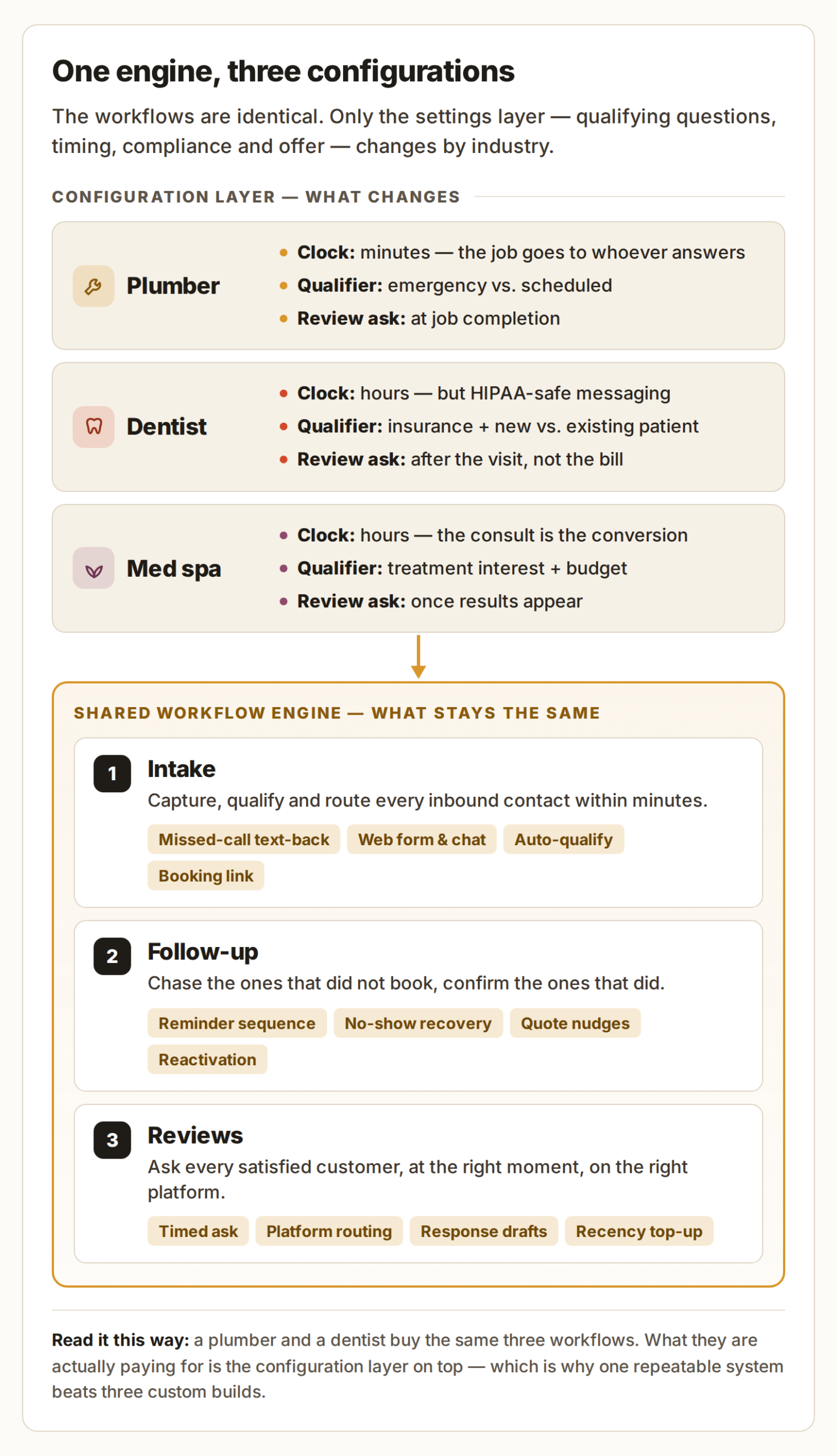
This has a direct commercial consequence. A business that quotes every local client as a bespoke build carries the cost of discovery, design and testing three times over, and gets slower as it grows. A business that ships one engine with three configuration profiles gets faster: the second dentist takes a third of the time the first one did, and the fifth takes a fraction. The same logic applies whether you are an agency selling this or an operator building it in-house across multiple locations.
How to roll this out in 30 days
The order matters. Intake first, because it protects demand you are already paying for. Follow-up second, because it works on contacts intake has now captured properly. Reviews third, because they compound and there is no point accelerating them before the first two are producing volume.
| Week | Focus | What ships | Signal it worked |
|---|---|---|---|
| 1 | Measure the leak | Call tracking, form tracking, and a two-week baseline of missed calls, unanswered forms and unbooked quotes | You can state your missed-contact rate as a number |
| 2 | Intake | Missed-call text-back, unified inbox, two qualifying questions, booking link, CRM record on every contact | Median first response under 5 minutes |
| 3 | Follow-up | Confirmation and unconverted sequences live, with reply-detection exits | No-show rate and quote-acceptance rate both move |
| 4 | Reviews and reporting | Post-service review requests, response drafting, and one dashboard covering all three workflows | Steady weekly review flow instead of bursts |
What to measure
Automation projects fail quietly when nobody agrees in advance what success looks like. Four numbers are enough, and all four should be visible on one screen.
| Metric | Definition | Workflow it proves |
|---|---|---|
| Speed to first response | Median minutes from enquiry to first human or automated reply | Intake |
| Contact capture rate | Share of inbound enquiries that end up as a CRM record with a next step | Intake |
| Booked-to-attended rate | Share of booked appointments or jobs that actually happen | Follow-up |
| Reviews per 100 completed jobs | New public reviews divided by completed services, tracked monthly | Reviews |
Four mistakes that make this fail
- Automating a broken process. If enquiries are lost because nobody owns the inbox, an automation just loses them faster and with better logging. Fix ownership first.
- Building for the exception. Teams spend weeks on the 5% of enquiries that need judgement and ship nothing for the 95% that need a fast, polite, structured reply. Route the exception to a human and move on.
- Treating compliance as an afterthought. Healthcare and aesthetics carry real constraints on what can be said in a text message and what can be stored where. Design the message templates around those rules rather than retrofitting them.
- Skipping the baseline. Without two weeks of before-data, nobody can tell whether the system worked, and the first quiet month becomes an argument instead of a diagnosis.
Frequently asked questions
What are the three automation workflows every local business needs?
Intake, follow-up, and review requests. Intake captures and qualifies every inbound enquiry within minutes. Follow-up chases unconverted quotes, confirms booked appointments, and reactivates dormant customers. Review requests turn every completed job into public proof. Together they address the three points where local service businesses lose revenue they have already paid to generate.
Which workflow should a local business automate first?
Intake, almost always. It is the only workflow that protects demand you are already paying to create, and it produces the clean contact records the other two workflows depend on. Follow-up should come second and review requests third.
Does a dental practice really need the same automation as a plumber?
The same three workflows, yes — configured differently. A dentist works to a longer response window, must handle patient information under stricter privacy rules, and runs recall cycles a plumber does not. The underlying architecture is identical; the qualifying questions, timings, message templates and compliance settings are what change.
How fast should a local business respond to an inbound enquiry?
Within five minutes for an automated acknowledgement, and within the hour for a real conversation. Harvard Business Review research found firms making contact inside the first hour were about 60 times more likely to qualify a lead than those that waited more than 24 hours. For emergency trades the practical window is shorter still, because the job goes to whoever picks up first.
Do automated appointment reminders actually reduce no-shows?
Yes, measurably. A Sesame Communications study of 1,604,184 dental appointments across 64 practices recorded a 22.95% reduction in no-shows after automated reminders were introduced, with the effect sustained over 36 months. MGMA’s 2025 poll of medical groups found practices crediting digital reminders and easy self-service rescheduling for flat or falling no-show rates.
Is it acceptable to ask customers for reviews automatically?
Asking is both acceptable and expected — BrightLocal’s 2026 survey found 83% of consumers who were asked went on to write a review. What is not acceptable is review gating: filtering out unhappy customers so only positive reviews reach the public. Send an internal satisfaction check first if you want to catch problems early, but every customer must still be able to leave a public review.
How much does local business automation cost to set up?
Cost depends far more on the configuration layer than on the workflows themselves, which is exactly the point of building once and configuring per industry. Expect the majority of a first engagement to go on discovery, message design and integration with whatever field-service, practice-management or booking software the business already runs — and expect the second business in the same vertical to cost meaningfully less.
Will automation make a local business feel impersonal?
Only if it is written that way. The alternative to an automated reply is usually no reply for six hours, which is considerably more impersonal. The rule that keeps it human is simple: automate acknowledgement, structure and timing; keep judgement, diagnosis and pricing conversations with a person.
The takeaway
The plumber, the dentist and the med spa are not three automation problems. They are one problem wearing three uniforms: answer faster, follow up without relying on memory, and ask every happy customer to say so in public. Build that engine once, configure it per industry, and the fourth client takes a fraction of the effort the first one did.