SaaS Marketing: The Complete Guide
Learn how SaaS marketing connects positioning, acquisition, activation, retention and revenue. Choose channels that fit your product and build a practical 90-day plan.
SaaS marketing is the work of helping the right people discover a software product, understand its value, become customers, and keep getting enough value to stay. A useful program connects positioning, acquisition, product activation, retention, and recurring revenue. It does not end when someone fills in a form or starts a trial.
For a founder or marketing team, the practical starting point is to choose one customer segment, define the problem your product solves, make the buying path clear, and measure what happens after acquisition. Then select channels that fit how those customers evaluate software and what your business can afford to spend winning them.
This guide provides a framework for making those choices, a worked funnel example, and a 90-day plan. The examples are hypothetical, not Scalematix client results.
What makes SaaS marketing different?
Software can be easy to sign up for and difficult to adopt. Buyers may need to connect data, invite colleagues, change a workflow, or persuade a budget owner before the product becomes useful. Your marketing must explain the outcome and help people reach it.
Recurring revenue adds another responsibility: the first purchase is only the beginning of the relationship. If customers leave before acquisition costs are recovered, more signups alone will not fix the business. Marketing therefore needs to work with product, sales, and customer success rather than report only website traffic or lead counts.
B2B products can also involve several audiences. The person who uses the software may care about daily work, while a manager cares about reporting and a technical reviewer cares about integrations and security. Consumer SaaS and simple team tools can have much shorter journeys. Do not build an enterprise buying process around a product people can evaluate independently.
Ahrefs describes education, multiple decision-makers, retention, and varied use cases as distinctive considerations in its own SaaS content program. Its experience is useful context, rather than a universal channel prescription. Source: Ahrefs: SaaS content marketing
Define the customer before choosing channels
An ideal customer profile is a working description of the accounts or people most likely to benefit from the product and become sustainable customers. A broad label such as “small businesses” is rarely specific enough to guide a campaign.
Write a one-page customer brief covering:
- Situation: What type of team or person is experiencing the problem?
- Trigger: What makes solving it urgent now?
- Current approach: What software, spreadsheet, process, or workaround do they use?
- Desired outcome: What should improve after adoption?
- Constraints: What integration, budget, implementation, or approval issues matter?
- Evidence: What have interviews, support conversations, sales notes, and customer behavior actually shown?
For example, a hypothetical scheduling SaaS could initially target multi-location service teams struggling to coordinate shift changes. That gives marketing a concrete problem to explain, a specific workflow to demonstrate, and a clear reason for a buyer to evaluate the product.
Interview successful customers and unsuccessful prospects. Ask what happened before they searched, what alternatives they considered, and what almost stopped them buying. Include people who abandoned a trial or cancelled. A customer profile based only on your happiest accounts can miss adoption problems.
Treat the profile as a hypothesis you can revise. Compare conversion, activation, support burden, and retention across segments before committing more budget to one.
Build positioning a buyer can understand
Positioning should explain who the product is for, what problem it solves, why its approach matters, and when another option might be a better fit. It is more useful than a long list of features without context.
For the scheduling example, “workforce management powered by innovation” gives the buyer little to evaluate. “Keep shift changes coordinated across locations without rebuilding the rota in spreadsheets” identifies a recognizable task. The product still has to substantiate that promise.
Check four places for consistency: the homepage, product or use-case pages, pricing page, and trial or demo experience. If an advertisement promises a quick independent setup but the product requires a lengthy implementation call, explain that before asking someone to sign up.
Build proof around claims you can support. Show an accurate product walkthrough, describe real integrations, explain implementation requirements, and use client evidence only with permission. When you have no verified case study, a clearly labeled example is better than an invented success story.
Ahrefs’ interviews with SaaS founders and marketing leaders emphasize clarifying the target customer and the reason to choose a product before expanding marketing spend. Source: Ahrefs: SaaS marketing strategies
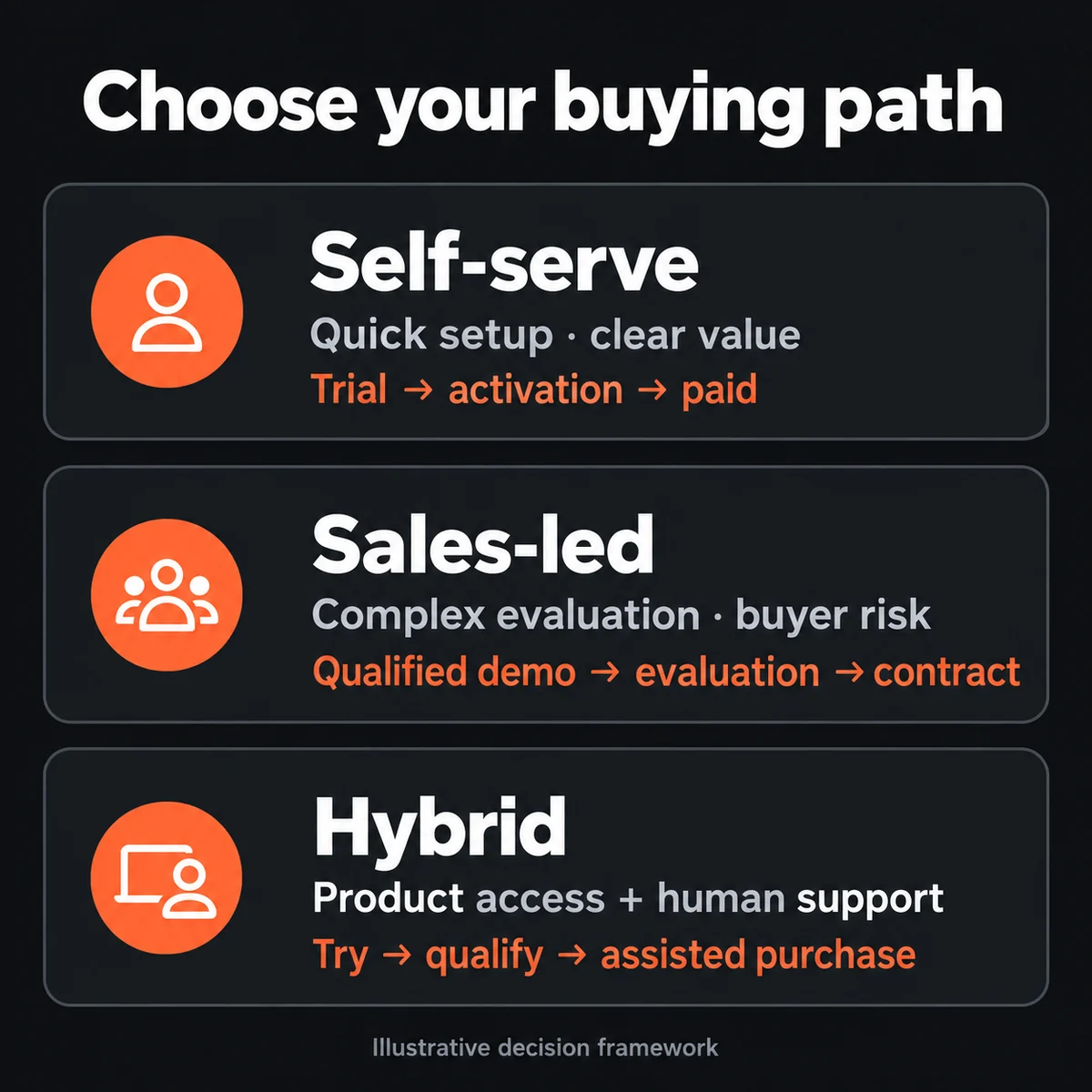
Choose a buying path: self-serve, sales-led, or hybrid
The right conversion action depends on how much buyers can learn and accomplish without assistance.
Self-serve
Use a self-serve path when people can understand the offer, access the product, and reach a useful outcome independently. A free trial provides access for a defined period; freemium provides an ongoing free tier with limits. Neither automatically creates growth. Both need a reason to start, a path to value, and a clear reason to pay.
Check that the first useful task is achievable with the access you offer. A trial that ends before a typical user can complete setup creates pressure without demonstrating value. A free tier that never exposes a meaningful paid need can generate usage without supporting the business.
Sales-led
A sales-led path is appropriate when evaluation needs discovery, tailored demonstrations, implementation planning, procurement, or risk review. The website should help buyers qualify themselves before a call: explain use cases, relevant requirements, how evaluation works, and what the next step involves.
Measure qualified opportunities and customer wins alongside demo requests. More bookings are not useful if they come from people the product cannot serve.
Hybrid
A hybrid path combines product access with assistance where it is valuable. Users may start independently, then request help when a team needs integrations, governance, purchasing support, or a broader rollout.
Define when sales should intervene. A product-qualified lead should reflect meaningful product behavior and customer fit, not simply a login. Marketing, product, and sales need a shared definition of that signal.
Amplitude’s product-led growth guide describes onboarding, product value, and continued engagement as connected parts of the customer journey. It supports using activation and retention to assess product-led acquisition rather than counting access alone. Source: Amplitude: product-led growth guide
Map the SaaS customer lifecycle
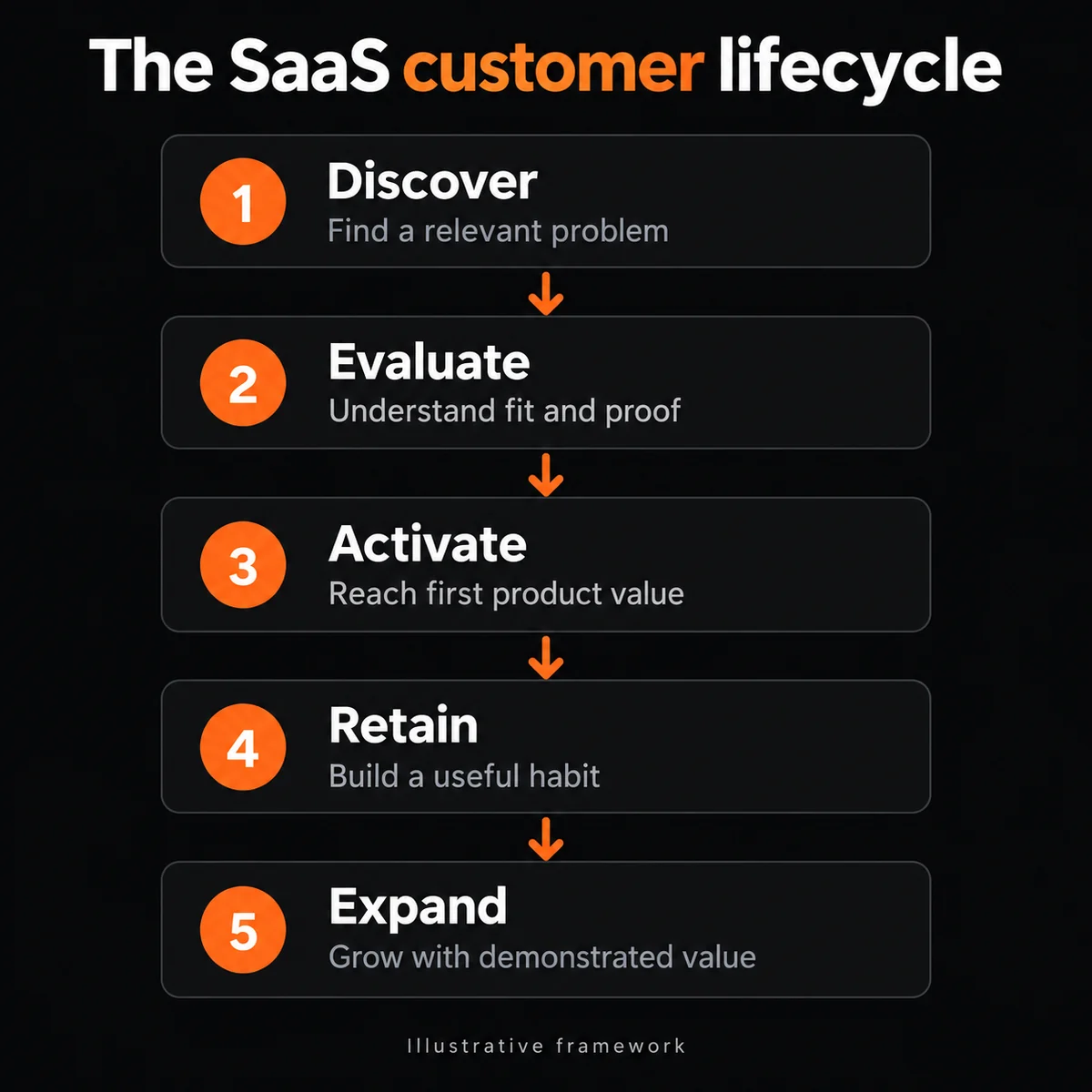
Use five stages to decide what information and assistance people need. They are a planning framework; real customers can revisit stages or take several routes.
- Discover: Recognize a problem and encounter a relevant product. Useful assets include problem-focused articles, practitioner discussions, partner introductions, and targeted campaigns.
- Evaluate: Decide whether the product fits. Use accurate product pages, demonstrations, transparent pricing information, implementation explanations, and fair comparisons.
- Activate: Complete the first task that delivers meaningful product value. Help people reach it with focused onboarding, appropriate prompts, and assistance when setup stalls.
- Retain: Keep getting value. Support continued adoption with education, useful reminders, service quality, and investigation of cancellation reasons.
- Expand: Adopt more capabilities, seats, or usage when the need is real. Explain the additional value and purchasing implications rather than sending upgrade messages indiscriminately.
For the scheduling example, signing up is not activation. Publishing a usable rota and having the team access it might be a more useful candidate event. Validate that event against subsequent behavior before treating it as a predictor of retention.
Assign an owner to each handoff. Marketing can attract the right audience, but it cannot solve a broken integration or an unsuitable product by sending more emails.
Select channels by buyer behavior and economics
Start with a small channel mix you can operate well. Ask where customers already look for solutions, whether demand exists for the problem, what proof they need, and how much human effort a sale can support.
Search and content
SEO can help people find answers while researching a task or comparing software. Prioritize topics connected to problems your product actually solves. A useful mix includes problem explanations, workflow tutorials, use cases, integration guidance, and fair alternative or comparison pages.
Show how the product helps when that is relevant. Include limitations and maintain screenshots as the interface changes. Avoid publishing a page for every keyword variation when the reader task is the same.
Ahrefs documents SEO-led content, free tools, research, community activity, and other channels in its own SaaS marketing program. That is an example of a real company’s approach, not evidence that every SaaS business needs all of those tactics. Source: Ahrefs: SaaS marketing
Paid acquisition
Paid search can be a useful experiment when buyers already search for the category or problem. Paid social may help reach a defined audience, but audience targeting alone does not establish purchase intent.
Choose a campaign outcome that matches the buying path. Track the journey from click to qualified trial or opportunity, then to a paying customer. Set a spend ceiling and a review date before launch. If the sample is small or the sales cycle is long, describe the result as provisional.
Scalematix’s performance marketing service explains how it connects paid media, conversion paths, and reporting: Explore performance marketing
Outbound and account-focused programs
For a defined B2B audience, targeted outreach can help test a use case or start conversations with relevant accounts. Begin with a credible reason to contact someone and a specific problem you can discuss. Observe the recipient’s jurisdiction, consent requirements, and opt-outs.
Judge the program by relevant conversations, qualified opportunities, and outcomes, not just the number of messages sent. Coordinate outreach with useful evaluation material rather than expecting a cold message to explain an entire product.
Partnerships, communities, and referrals
Explore integrations, service partners, practitioner communities, and customer recommendations where they already play a role in buying. Ask what value you can contribute before promoting the product.
A partnership needs clear expectations: audience fit, responsibilities, shared materials, lead handling, and a way to assess outcomes. A referral incentive cannot compensate for a product people are reluctant to recommend.
Email and lifecycle communication
Use lifecycle messages to help people do the next useful thing. A welcome email can explain the first task; a stalled-setup message can offer relevant help; a renewal message can clarify the upcoming term and value already delivered.
Make the message match the person’s actual stage. Stop sending trial reminders after payment, avoid promoting unavailable features, and respect communication preferences. Monitor assistance provided and downstream behavior, not only opens.
For a wider discussion of paid acquisition and longer-term growth, see Scalematix’s comparison of growth marketing and performance marketing: Read the growth vs. performance marketing comparison
Build a website that helps people evaluate
Your website should answer the questions that otherwise make evaluation slow or uncertain:
- What does the product do, and who is it designed for?
- What does the relevant workflow look like?
- What does setup require?
- Which integrations and capabilities are genuinely available?
- What is included in the plan, and what costs extra?
- What happens after a trial signup or demo request?
- Where can a buyer find accurate security, support, and implementation information?
Use a primary action suited to the page’s intent. A workflow explanation might point to a product walkthrough. A pricing page might offer a trial or a sales conversation. Every page does not need the same aggressive call to action.
Comparison pages should state the basis of the comparison and be updated when products change. Explain who each option suits. Do not claim unsupported superiority, invent competitor limitations, or present unverified pricing as current.
Include AI search without making it the whole strategy
Buyers may research software through AI-assisted search as well as conventional results, communities, and recommendations. Create information that helps them assess the product: clear use cases, precise capability descriptions, original examples, evidence, and accessible explanations of limitations.
Google’s guidance says established SEO practices remain relevant to AI Overviews and AI Mode. Eligible supporting pages need to be indexed and able to appear with a snippet; Google does not require a special AI schema or new AI text file. Eligibility does not guarantee inclusion. These statements concern Google Search, not every AI platform. Source: Google Search: AI features and your website
Track business outcomes from any identifiable AI referrals alongside other channels. A manual prompt check can reveal how a product is described at that moment, but it is not a stable ranking report or proof of market-wide visibility.
Measure acquisition, activation, and revenue together
Choose a compact set of metrics with agreed definitions and owners. Stripe groups SaaS metrics across acquisition, engagement, retention, growth, and economics. Recurring revenue measures exclude one-off fees; they should not be confused with all revenue or cash collected. Source: Stripe: essential SaaS metrics
For a useful operating report, track:
- Acquisition: Qualified trials or opportunities, new paying accounts, and acquisition cost.
- Activation: The share of an eligible signup cohort reaching a defined value event within a specified window.
- Conversion: Paid customers from a trial cohort, or wins from qualified opportunities, measured over an agreed time window.
- Retention: Continued customer or product use, cancellations, and recurring revenue retained by cohort.
- Revenue: New recurring revenue, expansion, contraction, and churn.
Customer acquisition cost (CAC) divides acquisition-related sales and marketing costs by new customers won. Include relevant people, tools, contractors, and advertising. Allocate activity serving existing customers separately when reporting new-customer CAC. Ben Murray’s CAC framework explains why the cost base, allocation policy, and customer unit must be defined consistently. Source: The SaaS CFO: acquisition cost framework
For reporting, pair CAC with gross margin, retention, and payback rather than declaring a channel successful from one number. A lower-cost customer who leaves quickly may be less valuable than a higher-cost customer who remains and uses the product successfully. Long sales cycles also mean spending and wins may occur in different periods; state your measurement method and review longer windows before interpreting a short-term change.
Net revenue retention (NRR) measures recurring revenue from an existing customer cohort after expansion, contraction, and churn. It excludes new-customer revenue. NRR above 100% can coexist with customer losses when expansion offsets them, so inspect customer retention separately. Source: Stripe: net revenue retention
A worked example: find the bottleneck before buying more traffic
Consider a hypothetical self-serve SaaS cohort. After allowing the full observation window to close, the team records:
- 2,000 relevant landing-page visits.
- 200 eligible trial signups.
- 80 trial accounts reaching the defined activation event.
- 20 trial accounts becoming new paying customers.
- $12,000 in acquisition-related sales and marketing costs allocated to the cohort.
The visit-to-trial rate is 200 ÷ 2,000 = 10%. The activation rate is 80 ÷ 200 = 40%. Trial-to-paid conversion is 20 ÷ 200 = 10%. The illustrated CAC is $12,000 ÷ 20 = $600.
These are invented inputs for explaining the calculation, not benchmarks or expected results.
Before buying more traffic, inspect where the 120 non-activated trial accounts stopped. Were they unsuitable customers? Did a required integration fail? Was the first task unclear? Did they have enough time and permissions to complete it?
Interview a sample, compare segments, and test the most plausible explanation. If the signup promise attracts the wrong audience, onboarding changes alone will not solve it. If qualified users stall during setup, a clearer path to value may be more useful than another advertising channel.
The arithmetic shows what happens if performance changes: 30 customers at the same $12,000 allocation would produce $400 CAC. It does not prove that a particular intervention will cause that outcome. Check acquisition quality, retention, and any additional support costs before scaling.
Build a practical 90-day SaaS marketing plan
The following is an illustrative sequence for a team that already has a usable product and some customer evidence. Enterprise sales or substantial implementation requirements can take longer than 90 days to yield revenue results.
Days 1–30: Establish the foundation
Choose one customer segment and interview customers and lost prospects. Review the buying path and identify the first meaningful product outcome. Agree definitions for trials, activation, qualified opportunities, paying customers, and retention windows.
Audit the key website pages and establish a reliable baseline. Check whether the analytics, CRM, product, and billing records can be reconciled. Finish the month with a specific customer brief, a clear conversion path, and one prioritized bottleneck.
Days 31–60: Run focused experiments
Choose one primary acquisition experiment and one activation or evaluation improvement. A small team might pair a high-intent landing page and paid search test with a simpler trial onboarding sequence. Another might pair account outreach with a useful evaluation guide and sales-assisted proof of value.
For each experiment, record the hypothesis, audience, owner, cost limit, observation window, success measure, and reason to stop. Change one major element at a time where practical, and keep qualitative feedback alongside the numbers.
Days 61–90: Decide what to continue
Review completed cohorts rather than mixing mature and recent signups. Compare customer fit, activation, revenue, support effort, and early retention. Continue tests that merit more evidence; stop spending on hypotheses the available evidence no longer supports.
Write the next plan around what you learned. Document which claims improved evaluation, which steps delayed value, and which channel brought suitable customers. For a longer sales cycle, the outcome may be a better-qualified pipeline and clearer evaluation process rather than a closed-revenue verdict.
How much should you spend?
There is no single marketing-budget percentage that fits every SaaS business. Set the budget around your stage, sales motion, available capacity, customer economics, and the evidence you need to collect.
Build the budget from the work: people, content and creative production, media, sales effort, tooling, and onboarding support. Protect the resources needed to help prospects evaluate and use the product. Spending the whole budget on traffic leaves nothing to fix the journey that follows.
Use cost limits and review points for experiments. Avoid estimating lifetime value confidently from a small or young customer base. Ask finance to review the assumptions behind acquisition and payback targets before using them to justify expansion.
Common mistakes to avoid
Copying another SaaS company’s channel mix. Your buyers, price, adoption requirements, and team capacity may be different.
Treating a signup as success. Inspect whether the account reaches value, pays, and stays.
Reporting ad cost as complete CAC. State exactly which expenses the figure includes.
Mixing different segments into one funnel. Separate self-serve and enterprise journeys when their behavior and economics differ.
Promising capabilities the product cannot deliver. Align campaigns, website copy, sales demonstrations, and onboarding with the current product.
Automating irrelevant messages. Use lifecycle context and clear preferences to make communication helpful.
Scaling before the observation window closes. A recent trial cohort or unfinished enterprise evaluation cannot provide a final conversion result.
Turn the guide into your next decision
A workable SaaS marketing program starts with a specific customer, a credible promise, and a clear route to product value. Channels bring people into that route; activation, retention, and revenue tell you whether the route works.
Your next step is to document one customer segment, identify one bottleneck in its buying journey, and assign a measurable experiment with an owner and a review date. Build evidence before expanding the program.
If you need help connecting those decisions to execution, explore Scalematix’s SaaS marketing services: Explore SaaS marketing services
To discuss your product, current funnel, and next priorities, send Scalematix a brief or book a strategy call through the contact page: Contact Scalematix
Let’s make
your next move.
LET’S TALK
Bring your ambition.
We’ll bring a different perspective.