Every missed call is a missed customer. That’s the problem small businesses have been trying to solve for decades — first with a receptionist at a desk, then with an outsourced live answering service, and now with two very different flavors of artificial intelligence: the AI receptionist and the AI chatbot. All three promise to make sure nobody who reaches out to your business gets silence in return. But they are not interchangeable, and picking the wrong one usually shows up later as lost leads, frustrated callers, or a bill that doesn’t match the value you’re getting.
This guide breaks down what an AI receptionist, a live answering service, and an AI chatbot actually do, how their costs and capabilities compare side by side, and which one (or combination) fits different types of small businesses. If you’ve already read our guide on how 24/7 AI call answering actually works, think of this as the next step: deciding whether an AI receptionist is even the right category for you in the first place, or whether a live service or a chatbot solves your specific problem better.
Quick Answer: What’s the Difference?
- AI receptionist — software that answers your business phone line using a natural-sounding AI voice, 24/7, and can book appointments, answer FAQs, qualify leads, and transfer urgent calls.
- Live answering service — a human agent (usually outsourced, sometimes overseas or in a call center) answers your calls on your behalf, following a script you provide.
- AI chatbot — a text-based assistant on your website, Facebook Messenger, or SMS that answers questions and captures leads, but does not pick up the phone.
If most of your missed opportunities come in by phone, an AI receptionist or a live answering service is the relevant comparison. If they come in through your website, a chatbot is a separate, complementary tool — not a substitute for either.
What Is an AI Receptionist?
An AI receptionist is a voice-based AI system connected directly to your business phone number. When a customer calls, the AI answers in a natural-sounding voice, greets them the way a trained employee would, and then handles the conversation: booking an appointment on your calendar, answering common questions about pricing or hours, collecting a caller’s details, or routing time-sensitive calls straight to you or your team. Because it’s software, it never takes a lunch break, never calls in sick, and can hold a dozen conversations at the exact same moment — something no single human receptionist, in-house or outsourced, can do.
The trade-off is nuance. A modern AI receptionist handles the vast majority of routine calls extremely well, but it can still stumble on highly unusual requests, strong accents, or emotionally charged situations where a caller needs to feel heard by a person, not a system. Most providers solve this with a fallback rule: if the AI isn’t confident, it transfers to a human.
What Is a Live Answering Service?
A live answering service is a company you outsource your call answering to. A real person, usually working from a script and a knowledge base you provide, answers your business calls, takes messages, and in more advanced plans can also book appointments or transfer calls. Because a human is on the other end, live services are generally better at reading emotional context — an upset customer, a confused first-time caller, a delicate situation.
The cost of that human touch is exactly that: cost. Live answering services typically charge per minute or per call, and pricing climbs quickly once call volume grows. Staffing also means coverage gaps are possible during peak times, holidays, or overnight unless you pay for premium round-the-clock plans, and consistency can vary between agents even within the same company.
What Is an AI Chatbot?
An AI chatbot lives on your website, in a Facebook Messenger window, or inside SMS, and answers questions through text rather than voice. It’s excellent at instantly engaging a visitor who’s browsing your site at 11 p.m., answering FAQs, qualifying a lead before a human follows up, and capturing contact details that would otherwise walk away as an anonymous, un-retargetable visit.
What a chatbot cannot do is pick up your business phone line. If your customers are the type who call rather than type — common in home services, healthcare, legal, and local trades — a chatbot alone will leave your biggest lead-generation channel completely uncovered.
Side-by-Side Comparison
| Factor | AI Receptionist | Live Answering Service | AI Chatbot |
|---|---|---|---|
| Channel | Phone calls | Phone calls | Website chat / SMS / Messenger |
| Availability | 24/7/365 | 24/7 on premium plans; often business hours only on base plans | 24/7/365 |
| Typical monthly cost (small business) | $50–$400 flat or usage-based | $300–$1,000+, billed per minute | $0–$150, many free tiers |
| Handles appointment booking | Yes, direct calendar integration | Sometimes, on higher-tier plans | Yes, for web-based bookings |
| Scales with call spikes | Yes, instantly, no extra staffing | Limited by agent headcount | Not applicable (text only) |
| Best for emotionally sensitive calls | Fair (escalates to human) | Strong | Weak |
| Setup time | Same day to a few days | 1–2 weeks (scripting, training) | Hours to a day |
| Consistency | Identical every call | Varies by agent/shift | Identical every chat |
Visual Comparison
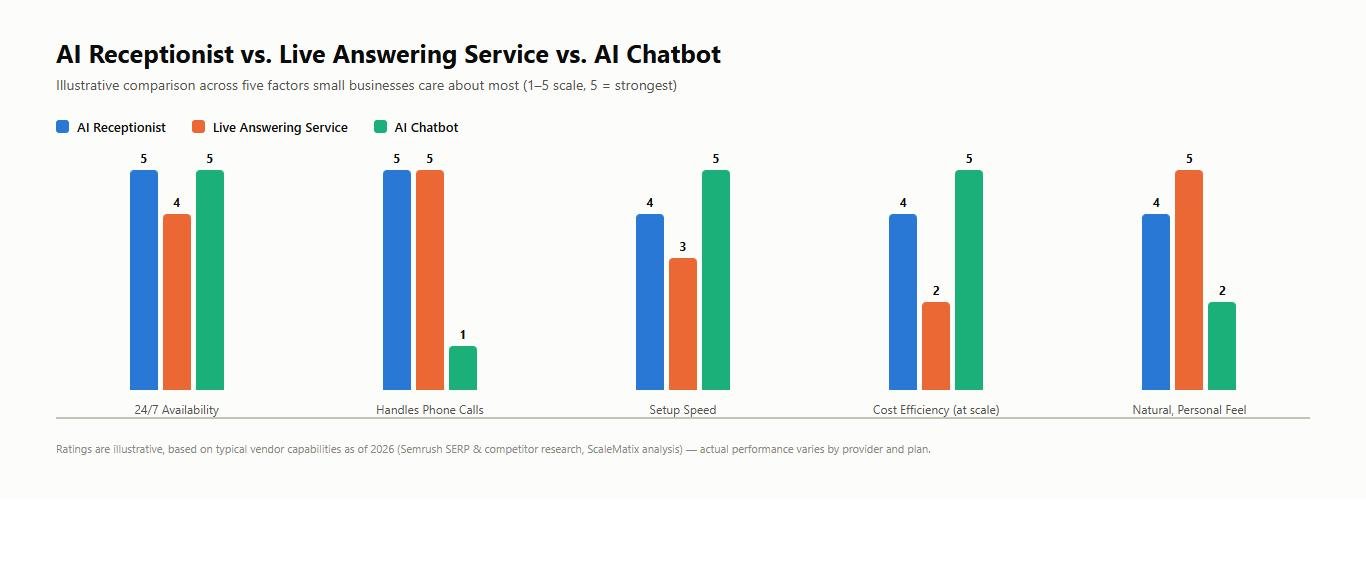
As the chart shows, no single option wins on every factor — an AI receptionist is the only one of the three that combines full phone coverage with 24/7 availability and cost efficiency at scale, which is why it’s become the default recommendation for small businesses that live or die by the phone.
Cost: What You’re Really Paying For
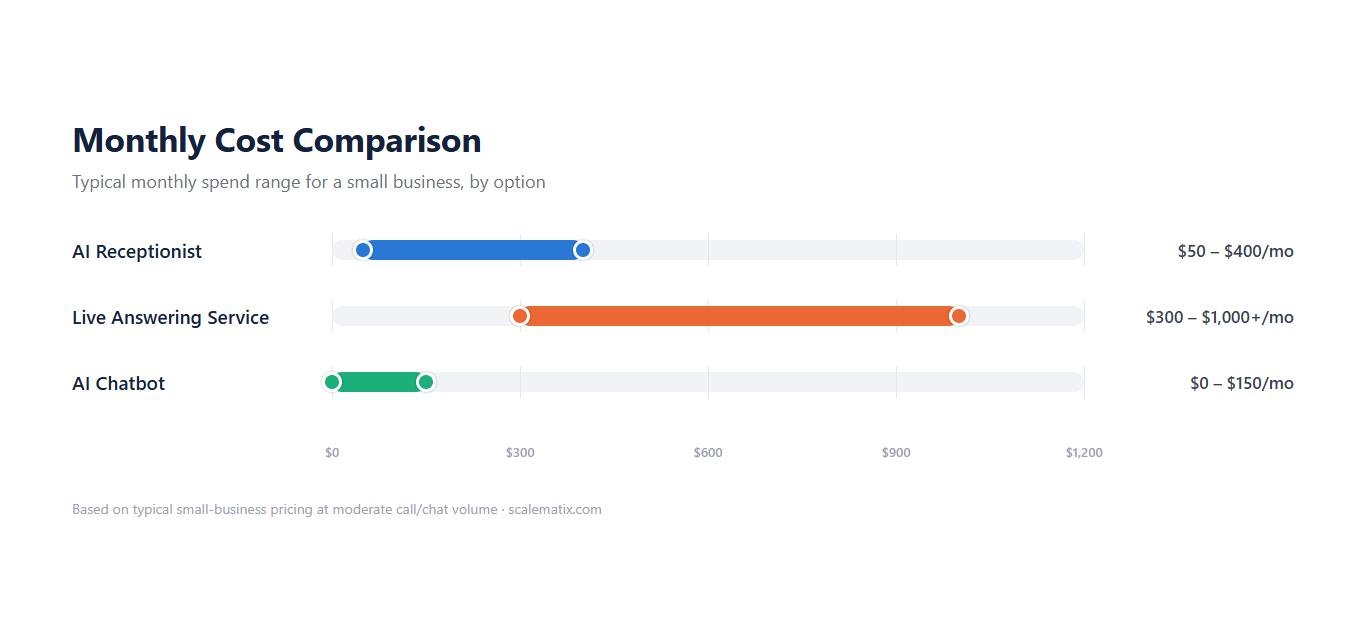
Live answering services almost always bill per minute of talk time, which means your bill grows in direct proportion to your business’s success — the busier you get, the more expensive the service becomes, right when you can least afford the distraction of renegotiating a contract. A typical small business fielding a few hundred calls a month can expect to pay anywhere from $300 to well over $1,000 monthly for a quality live service.
AI receptionists usually work on a flat monthly fee or a much cheaper usage-based model, because the marginal cost of the AI handling one more call is close to zero. Most small business plans land between $50 and $400 a month, even at higher call volumes, which is why cost efficiency is one of the clearest differentiators once a business gets past a handful of calls a day.
AI chatbots are typically the cheapest entry point, with many usable free tiers and paid plans rarely exceeding $150 a month, but remember: they solve a different problem (web visitors, not phone callers), so comparing their cost directly to a receptionist or answering service isn’t quite apples-to-apples.
Which One Fits Your Business?
Solo operators and very small teams (1–5 people)
An AI receptionist is usually the highest-leverage choice. You get 24/7 phone coverage without hiring, without per-minute anxiety, and without training a new person every time someone leaves.
Medical, dental, and healthcare practices
Patients expect to book, reschedule, and ask insurance questions at any hour. An AI receptionist that integrates with your scheduling system handles the volume, while urgent or sensitive calls can still be routed to a human on call.
Law firms and professional services
First-call response time is directly tied to client acquisition in legal and professional services. An AI receptionist that captures intake details instantly, paired with a chatbot on your site for after-hours browsers doing research, covers both channels.
High call-volume trades (HVAC, plumbing, electricians)
Emergency calls at 2 a.m. are exactly the scenario where an AI receptionist earns its cost back the fastest — a missed emergency call is a missed job, and often a lost customer for life.
Businesses with a strong emotional-support component
If a meaningful share of your calls involve upset, anxious, or grieving customers — funeral homes, certain healthcare specialties, insurance claims — a live answering service (or a hybrid, with AI handling routine calls and live agents on standby for escalations) is worth the extra cost.
E-commerce and content-driven businesses
If your customers rarely call and instead browse and ask questions on your website, a chatbot is the priority, with a lightweight AI receptionist as backup for the calls that do come in.
How to Choose: 6 Questions to Ask Before You Decide
Before comparing feature lists or pricing pages, answer these questions honestly about your own business. They’ll narrow the decision faster than any spec sheet.
- Where do most of your missed opportunities actually come from — the phone, your website, or both? If you’ve never tracked this, spend two weeks logging it. It changes the entire recommendation.
- How much does a single missed call cost you? For a $2,000 average job, even a 5% improvement in call capture can pay for a year of an AI receptionist in a single booked appointment.
- How often do calls involve genuinely sensitive or unusual situations? The higher this number, the more weight a live answering service (or a hybrid model) should carry.
- How fast do you need to be live? A live answering service needs real onboarding time to script and train agents; an AI receptionist can typically be configured and answering calls within days.
- Do you already use scheduling or CRM software? Look for a solution that integrates directly — the value of an AI receptionist drops sharply if someone still has to manually transfer booking details afterward.
- What happens after hours today? If the honest answer is “voicemail” or “nothing,” you already have your baseline, and almost any of these three options will outperform it.
A Real-World Scenario
Picture a five-person plumbing company. Historically, calls that came in during business hours were handled fine, but anything after 6 p.m. or on weekends went to voicemail — and emergency plumbing calls rarely wait until Monday morning. After switching to an AI receptionist, every after-hours call is answered immediately: routine questions get handled on the spot, appointment requests go straight onto the calendar, and true emergencies are flagged and forwarded to the on-call technician’s cell phone within seconds. The company didn’t hire a night-shift employee or sign a per-minute contract with a call center — it added a flat-fee AI layer on top of the phone number it already had. That’s the pattern that tends to repeat across the businesses where an AI receptionist makes the most sense: the value isn’t replacing a receptionist who already exists, it’s covering the hours and call spikes no human schedule realistically can.
Common Myths, Debunked
“AI receptionists sound robotic.” Early voice AI did. The current generation of AI receptionists uses conversational speech models that most callers don’t immediately flag as artificial, and quality keeps improving quickly.
“It’s only for big companies with call centers.” The opposite is closer to true — flat, usage-friendly pricing tends to make AI receptionists proportionally more valuable for small businesses than for enterprises with in-house staff to spare.
“A chatbot is basically the same thing.” As covered above, a chatbot never touches your phone line. For phone-first businesses, this isn’t a minor gap — it’s the whole problem left unsolved.
Can You Use More Than One?
Yes — and for many small businesses, the best setup isn’t “either/or.” A common, cost-effective stack looks like this: an AI receptionist covers every phone call around the clock, a chatbot covers the website for visitors who’d rather type than talk, and a live answering service (or your own staff) is reserved only for calls the AI flags as sensitive or high-stakes. This layered approach, which we cover in more detail in our guide to AI automation for small businesses, tends to deliver the best return because each tool is doing the job it’s actually best at, instead of being stretched to cover a channel it wasn’t built for.
Frequently Asked Questions
Is an AI receptionist better than a live answering service?
Neither is universally “better” — an AI receptionist wins on cost, availability, and consistency, while a live answering service wins on emotional nuance and handling truly unusual conversations. Most small businesses get the best value from an AI receptionist as the default, with a human fallback for edge cases.
Can an AI chatbot replace an AI receptionist?
No. A chatbot only handles text-based channels like your website or SMS. If customers call your business phone number, you still need an AI receptionist or a live service to answer that call.
How much does an AI receptionist cost for a small business?
Most small business plans range from about $50 to $400 per month depending on call volume and features like calendar booking or CRM integration, which is typically far less than a comparable live answering service.
Will customers know they’re talking to an AI?
Modern AI receptionists use natural, conversational voices, and many businesses disclose it upfront. Most callers care far more about getting a fast, accurate answer than about who (or what) is on the other end of the line.
What happens if the AI receptionist can’t answer a question?
Quality providers build in an escalation path: if the AI is unsure or the caller explicitly asks for a person, the call transfers to a live team member or a designated on-call number instead of leaving the caller stuck.
Do I need both an AI receptionist and a live answering service?
Most small businesses don’t need both running full-time, but a hybrid — AI handling the volume, a human on standby for flagged calls — is a common and cost-effective middle ground once call volume or complexity grows.
The Bottom Line
If your business depends on the phone ringing, start with an AI receptionist — it delivers the closest thing to full-time front-desk coverage at a fraction of the cost of a live service, without the scheduling gaps. Layer in a chatbot to catch website visitors, and keep a live answering service or your own team in reserve for the calls that genuinely need a human touch. Getting this mix right is less about picking a winner and more about matching each tool to the channel and situation it handles best.