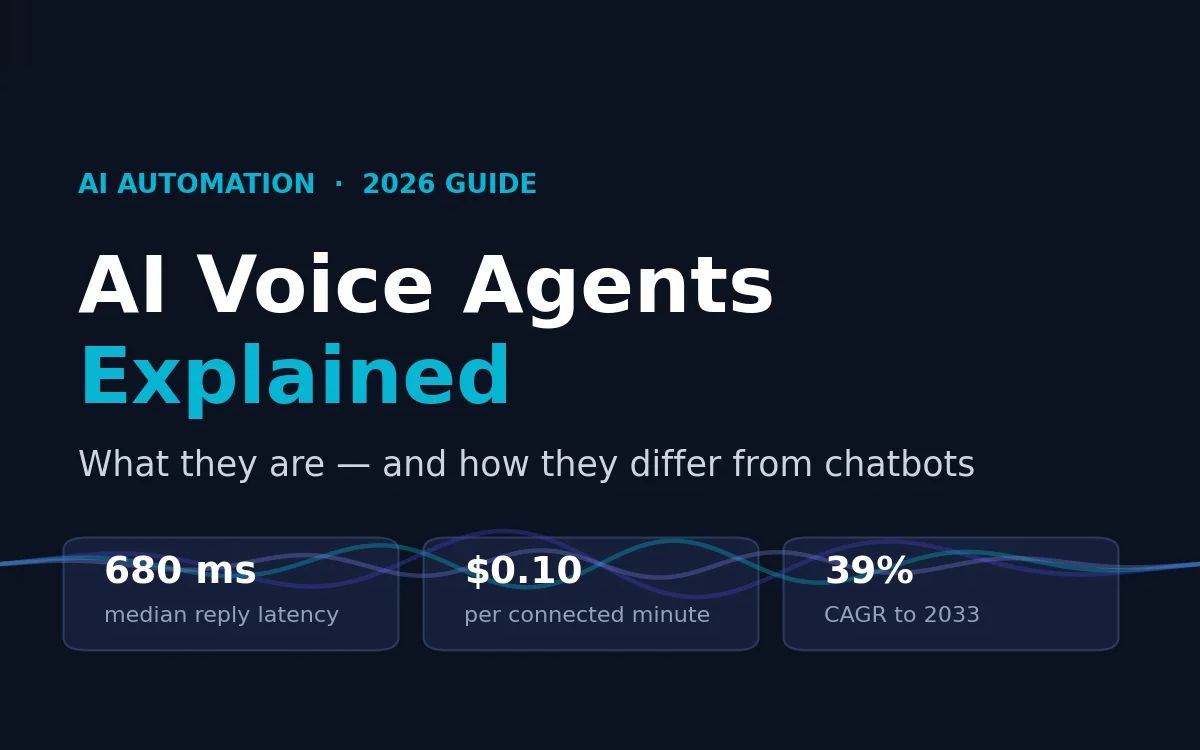
For three decades, calling a business meant surrendering to a menu. Press 1 for billing. Press 2 for support. The system could not hear you; it could only count your keypresses. That era is ending, and it is ending quickly. A new generation of AI voice agents now answers the phone, understands what a caller actually said, reasons about it, and takes real action — booking the appointment, checking the order, updating the record — before hanging up. If you have spent the last few years evaluating chatbots, this is a genuinely different category of software, and the distinction matters more than the shared vocabulary suggests.
What Is an AI Voice Agent?
An AI voice agent is software that holds a spoken conversation over the phone or in an app, understands natural speech without menus or keywords, and completes tasks on the caller’s behalf by connecting to your business systems. It combines speech recognition, a large language model, and speech synthesis into a single real-time loop that runs in well under a second.
The word that carries the weight in that definition is agent. A bot answers. An agent acts. When a caller says “I need to move Tuesday’s appointment to next week, ideally in the morning,” a voice AI agent does not merely transcribe the sentence — it interprets the intent, queries the calendar through an API, evaluates the available slots against the stated preference, proposes one aloud, and writes the change back to the CRM once the caller agrees. Everything in that chain happens while the line is still open and the caller is still listening.
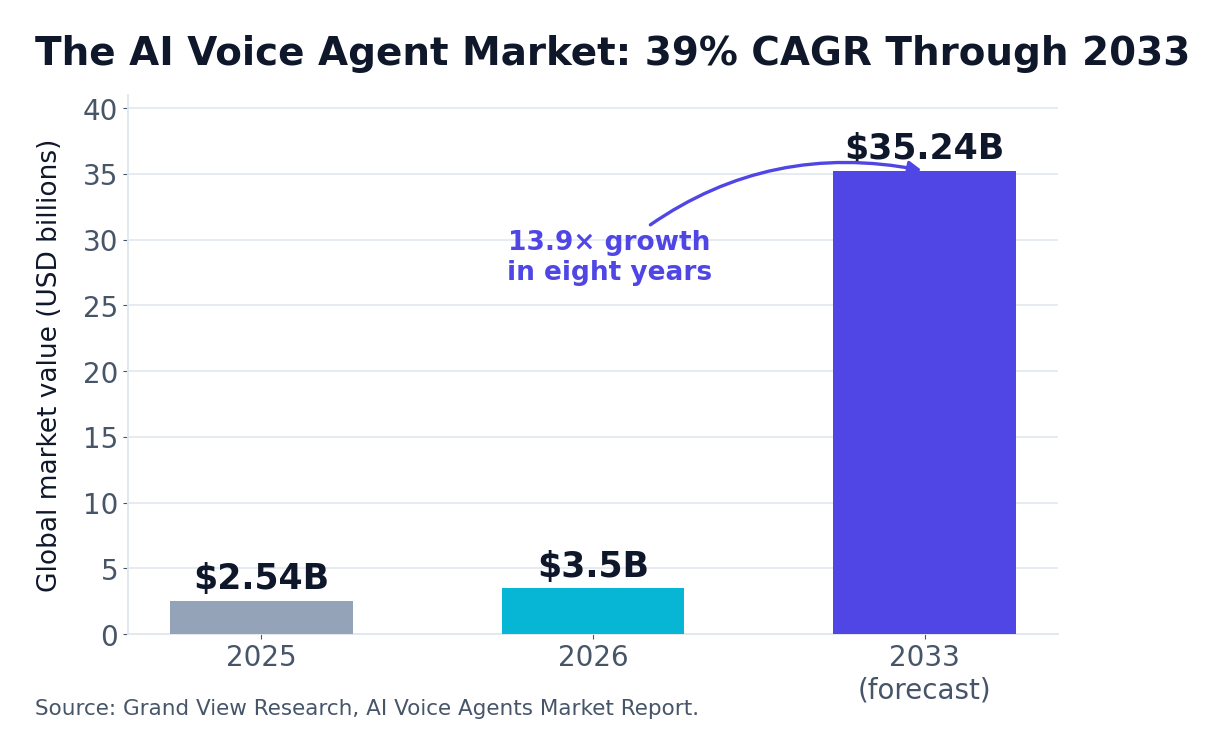
That capability is why the category is growing so aggressively. The global market for AI voice agents was valued at roughly $2.54 billion in 2025 and is projected to reach $35.24 billion by 2033 — a compound annual growth rate of 39%.
Voice agent, voice bot, conversational AI: which term means what
The terminology is genuinely muddled, so it is worth untangling before we go further.
- Conversational AI is the umbrella discipline — any technology that lets a machine hold a human-like dialogue, in text or in speech.
- Chatbot refers to a text-based conversational AI agent, historically rule-based and confined to a website widget. A conversational AI chatbot is its LLM-powered successor, and a conversational AI assistant is the same idea with a broader remit.
- Voice bot and AI voice bot are used more or less interchangeably with voice agent, though “bot” often implies the older, scripted generation.
- AI voice agent (or voice AI agent) is the current term of art for an LLM-powered system that can reason and call tools, not merely follow a decision tree.
- Conversational AI voice agents is simply the intersection of the two — the precise subject of this guide.
Where “bot” implies a script, “agent” implies autonomy. That single distinction explains most of the confusion in the market.
How AI Voice Agents Work: Inside the Pipeline
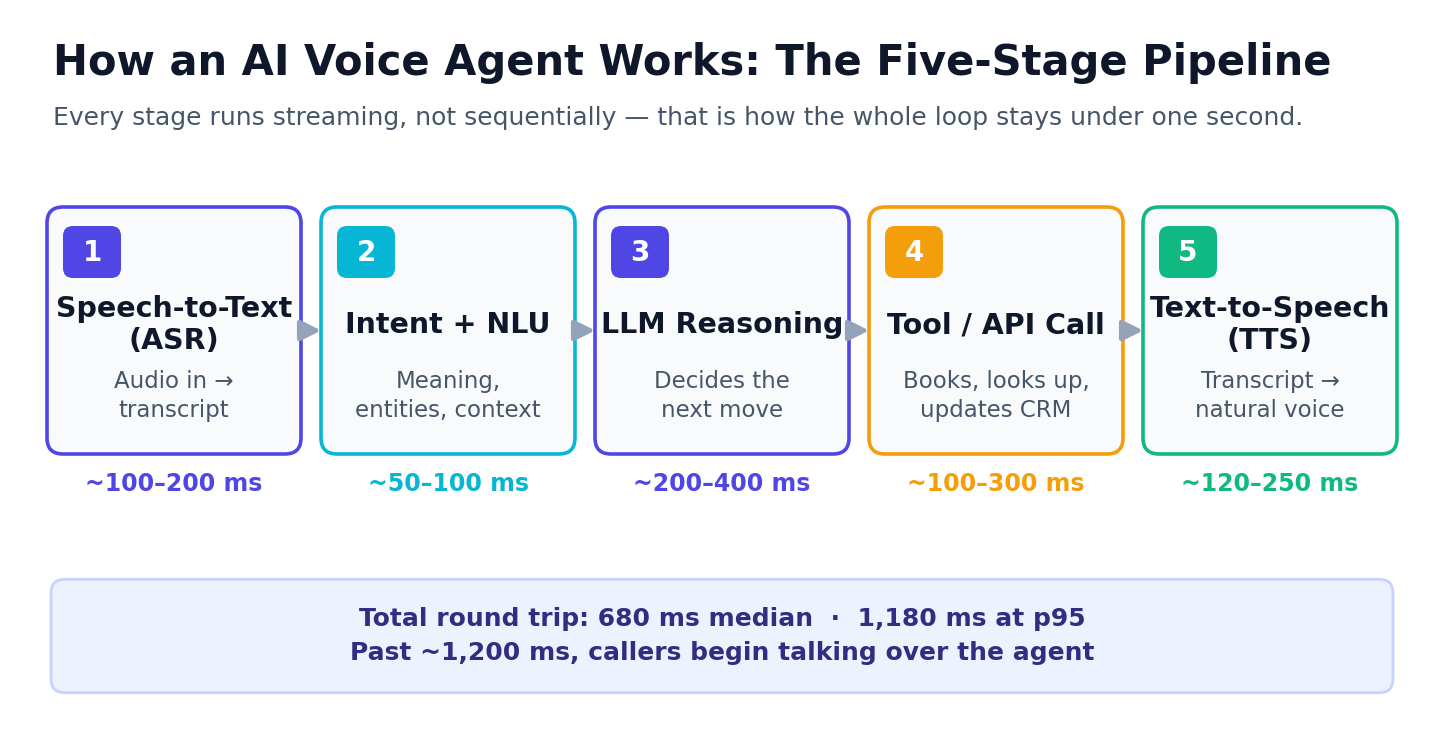
How does conversational AI work once you put it on a phone line? Understanding how conversational AI works in a voice context is largely a matter of understanding five stages and one constraint. The stages are speech recognition, intent understanding, reasoning, action, and speech synthesis. The constraint is latency: a human conversational turn feels natural at roughly 200 to 300 milliseconds of silence, and callers begin talking over an agent that takes much longer than a second to respond. Every architectural decision in a voice pipeline is, ultimately, a negotiation with that budget. Natural language processing in conversational AI is the discipline that makes the middle three stages possible.
Steps 1–2: Speech-to-text and intent understanding
Automatic speech recognition (ASR), also called speech-to-text, converts the incoming audio stream into words. Modern systems transcribe incrementally rather than waiting for the caller to finish, which shaves precious milliseconds off the loop. Natural language understanding (NLU) then extracts meaning from that transcript: the intent (“reschedule an appointment”) and the entities that qualify it (“Tuesday,” “next week,” “morning”). Intent classification is the shared foundation beneath both chatbots and voice agents — but a voice agent must perform it against speech that contains hesitations, accents, background noise and self-corrections, which is a materially harder problem than parsing typed text.
Steps 3–4: LLM reasoning and tool calls
This is the layer that separates a contemporary voice agent from a legacy voice bot. A large language model receives the transcript, the conversation history, and a set of instructions describing the agent’s role and boundaries. It then decides what to do next. Crucially, it can invoke external functions — a capability usually called function calling or tool use. The agent queries your booking system, your inventory database or your CRM through ordinary API integrations, waits for the response, and folds the result into its reply. Without this step an agent can converse pleasantly and accomplish nothing; with it, the call ends in a completed transaction rather than a promise to call back.
Step 5: Text-to-speech, latency and interruption handling
Text-to-speech (TTS) renders the reply as audio. Contemporary speech synthesis is close to indistinguishable from a recorded human voice, and voice cloning lets brands deploy a consistent custom voice across every line. The subtler engineering challenge is turn-taking. A competent agent must handle barge-in — stopping mid-sentence the instant a caller interrupts — and must distinguish a thoughtful pause from a finished sentence. Getting this wrong is the single most common reason a technically functional agent feels unbearable to talk to. Across production deployments, median end-to-end response time lands near 680 milliseconds, with the 95th percentile around 1,180 milliseconds. Reducing AI voice agent interruptions is mostly a matter of tuning endpointing thresholds and streaming every stage rather than batching them.
AI Voice Agents vs. Chatbots: The 7 Key Differences
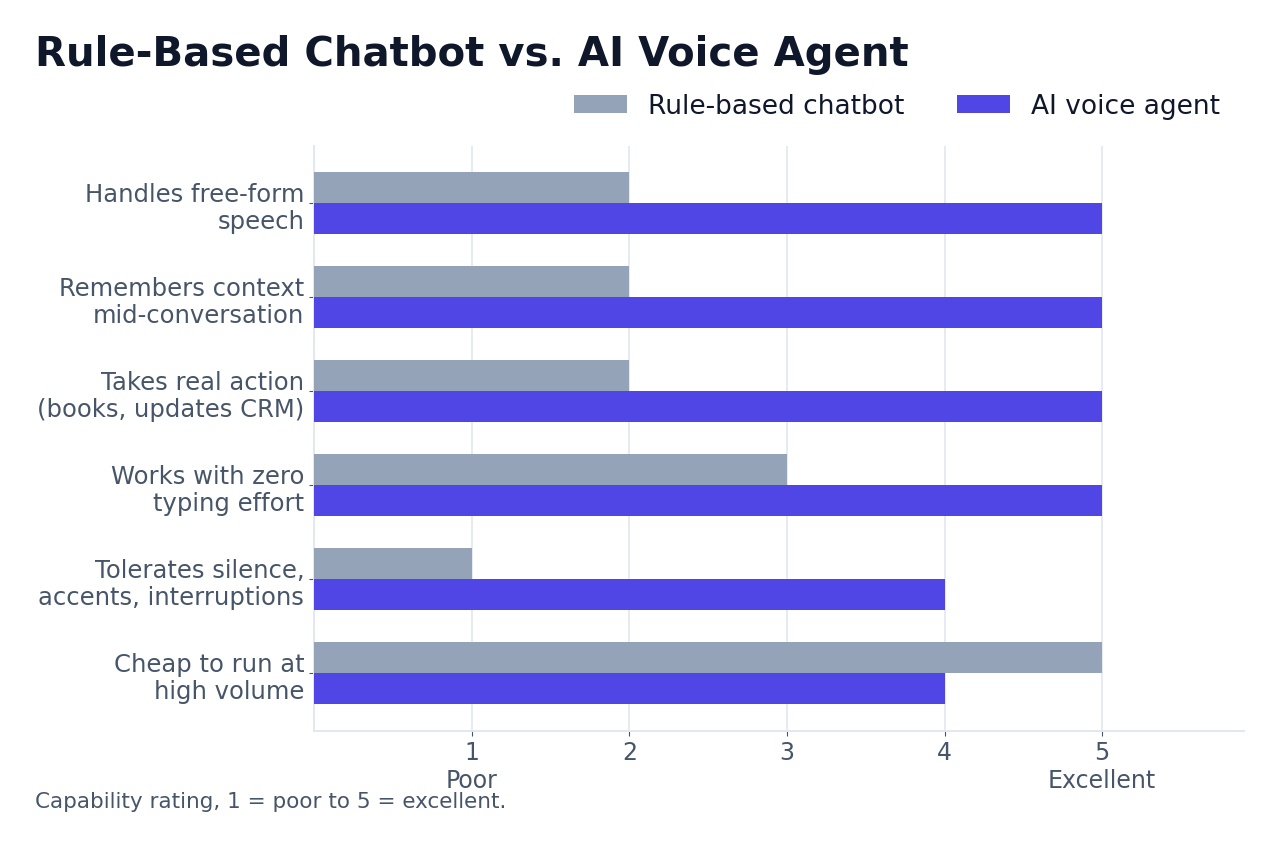
The chatbot vs conversational AI question — asked just as often as conversational AI vs chatbot, or chatbots vs conversational AI — is usually framed as a technology comparison. It is more useful to frame it as a comparison of what each one can be trusted to finish. Here is how conversational AI differs from basic chatbots across the seven dimensions that decide real deployments.
- Input modality. A chatbot reads typed text and can rely on it being clean. A voice agent listens, and must contend with crosstalk, dialects, poor reception and half-finished thoughts. Speech is a far noisier channel than a keyboard.
- Comprehension model. A classic rule-based chatbot matches keywords against a decision tree; step outside its script and it collapses into “I didn’t quite catch that.” An LLM-powered voice agent interprets meaning, tolerates paraphrase, and recovers gracefully from ambiguity.
- Memory and context. Chatbots typically treat each message as a discrete event. A voice agent maintains conversational state across the whole call, so “make it the later one instead” resolves correctly three turns after the options were offered.
- Ability to act. This is the decisive difference. Many chatbots retrieve information; agents execute tasks. Booking, rescheduling, payment reminders, order tracking and record updates all require tool calling, and a voice agent is architected around it.
- Latency tolerance. A chat user will happily wait three seconds for a reply. A caller will not wait one. Voice imposes a real-time constraint that fundamentally changes the engineering.
- Effort demanded of the customer. Speaking is the lowest-friction interface humans have. It requires no app, no typing, no screen — which is why voice reaches demographics and moments that chat simply cannot.
- Concurrency and economics. A voice agent handles hundreds of simultaneous calls without a queue, and it is billed per connected minute rather than per seat. That inverts the cost curve of a traditional contact centre.
Comparison table: chatbot vs. AI voice agent
| Dimension | Rule-based chatbot | AI voice agent |
|---|---|---|
| Channel | Text widget, SMS, messaging apps | Phone, app, smart speaker |
| Understanding | Keywords and decision trees | NLU plus LLM reasoning |
| Off-script queries | Fails or escalates | Interprets and adapts |
| Takes action | Rarely; usually links out | Yes, via API and function calls |
| Response budget | 1–3 seconds | Under 1 second |
| Typical pricing | Per seat or per resolution | Per connected minute |
| Best suited to | FAQs, order status, lead capture | Bookings, qualification, live support |
AI Voice Agents vs. Traditional IVR Systems
Almost every published comparison pits voice agents against chatbots. Far fewer address the system they are actually replacing: interactive voice response. An IVR — the auto attendant behind every “press 1 for…” menu — is a routing mechanism, not a conversation. It cannot understand speech; it maps keypresses to branches. Even conversational IVR, which adds keyword spotting, is a thin layer of NLU over the same rigid tree.
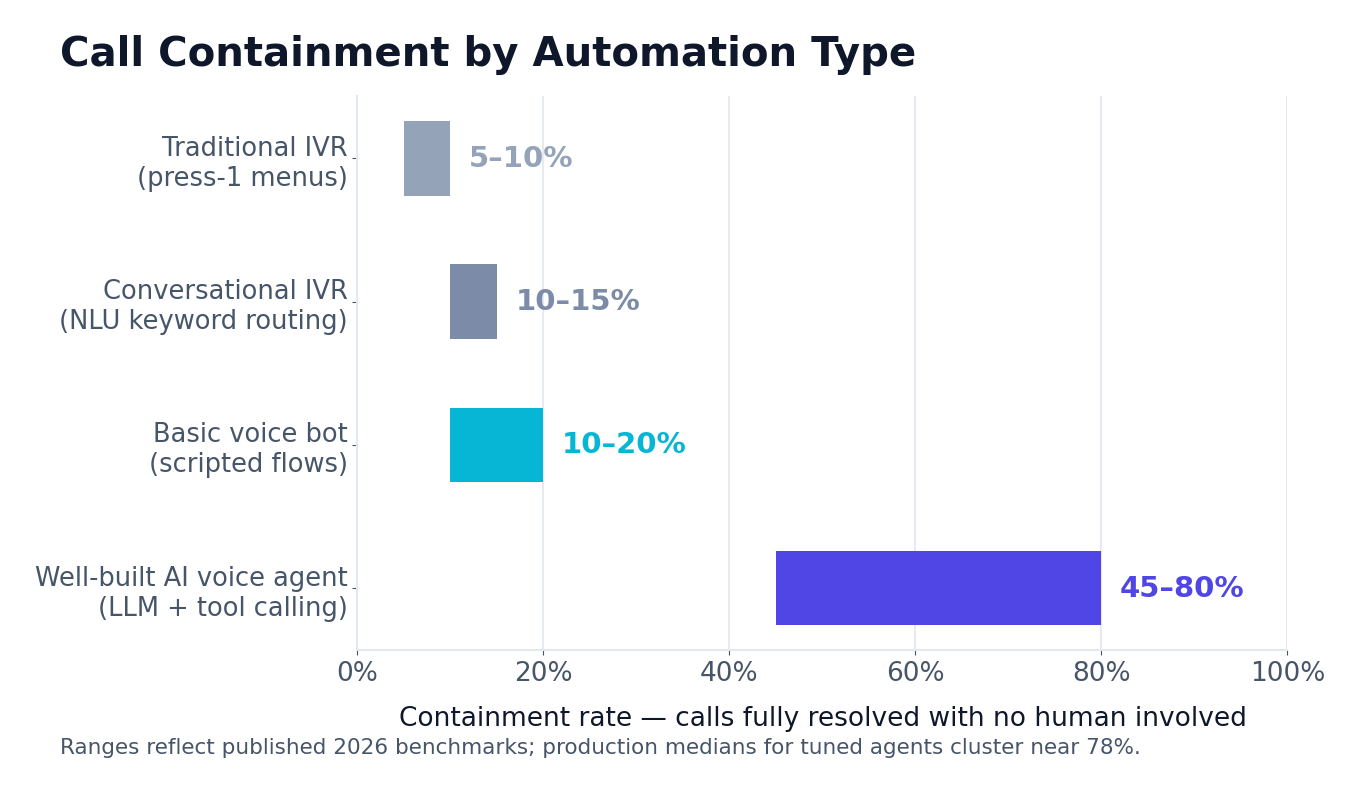
The gap shows up starkly in containment rate — the proportion of calls fully resolved without a human. Traditional menu-driven IVR contains roughly 5–10% of calls. An interactive voice response bot with keyword routing manages perhaps 10–15%. Well-implemented AI voice agents with genuine tool access operate in a different band entirely, with tuned production systems clustering near 78%.
There is a second, less quantifiable difference: callers loathe IVR menus and do not, on the whole, loathe a competent voice agent. Replacing a menu tree with a system that opens by asking “How can I help you today?” removes an entire category of customer frustration.
Conversational AI vs. Generative AI: Clearing Up the Confusion
The conversational AI vs generative AI question surfaces in nearly every buying conversation, and the confusion is understandable because the two categories now overlap heavily. The cleanest way to hold the distinction is this: conversational AI describes a purpose, while generative AI describes a capability.
Conversational AI is any system built to conduct dialogue with a person. Generative AI is any model that produces novel content — text, images, audio, code — rather than selecting from predefined options. What is the difference between conversational AI and generative AI in practice? Conversational AI existed long before generative models: a 2015 IVR with keyword matching was conversational AI, and it generated nothing. Today’s voice agents are conversational AI systems that use generative models as their reasoning engine, which is precisely why they are so much more capable than their predecessors.
Is conversational AI generative AI? Not necessarily — the two overlap without being identical. Is ChatGPT conversational AI? Yes — it is a generative model deployed in a conversational interface, which makes it both. The categories are orthogonal, not opposed. A useful rule: ask whether the system’s job is to talk to someone (conversational AI) or whether its method is to create new output (generative AI). Most modern voice agents answer yes to both.
What AI Voice Agents Are Actually Used For
What is an example of conversational AI actually earning its keep? The conversational AI use cases that generate real return share a common profile: high call volume, repetitive structure, and a clear system of record the agent can read from and write to. Inbound voice agents currently account for around 52% of the market, though outbound deployments are the faster-growing segment. Below are the three applications where conversational AI examples most reliably pay for themselves.
Inbound customer service and support
An AI voice agent for customer service answers on the first ring, at three in the morning, in whichever of a dozen languages the caller opens with. It handles order tracking, account queries, password resets, payment reminders and returns end to end, and escalates cleanly when it cannot. Conversational AI for customer service works best when the agent is granted genuine read-write access to the helpdesk — a voice bot for a call center that can only read is a glorified FAQ.
Healthcare, clinics and appointment booking
Conversational AI in healthcare is among the highest-value applications, largely because clinic phone lines are chronically overwhelmed and every missed call is a lost appointment. An AI voice agent in healthcare books, confirms, reschedules and cancels against the practice management system, runs reminder campaigns that measurably reduce no-shows, and triages routine questions away from clinical staff. If you are exploring this specifically, our guide to the AI receptionist for clinics and small businesses covers implementation in depth. Conversational AI for healthcare carries obligations other verticals do not: any healthcare conversational AI deployment must address data handling, consent and audit logging before it takes a single call.
Outbound sales and lead qualification
An outbound AI voice agent calls inbound leads within seconds of form submission — the window in which contact rates are dramatically higher — asks qualifying questions, and books qualified prospects straight into a sales calendar. An AI voice sales agent will not close a complex enterprise deal, and should not be asked to. What it does exceptionally well is the volume work that human reps resent: first-touch follow-up, list qualification, reactivation campaigns and appointment setting. Used for AI voice agent cold calling, it must be paired with rigorous consent and do-not-call compliance.
Beyond these, adoption is spreading fast in hospitality, logistics, insurance and financial services — BFSI currently leads all verticals in deployment, and an AI voice agent for real estate is now a standard fixture in high-volume brokerages. Demand has also produced a services layer around the technology: conversational AI companies, conversational AI consulting practices, specialist AI voice agent agency partners, and AI voice agent services for businesses that would rather buy the outcome than build the stack. Enterprise conversational AI programmes almost always begin in a single department and expand from there.
Benefits and Honest Limitations
Why is conversational AI more scalable than traditional support models? Because its capacity is a configuration setting rather than a hiring plan. Concurrency is effectively unlimited, availability is continuous, quality does not degrade at 6pm on a Friday, and every call is transcribed, tagged and available for sentiment analysis and conversation analytics — which is a substantial intelligence asset most contact centres never had.
The limitations deserve equal billing, and any vendor unwilling to discuss them is telling you something.
- Hallucination. LLMs can state confident falsehoods. Production agents require guardrails: retrieval grounded in your own documentation, constrained response templates for regulated content, and refusal behaviour for anything outside scope.
- Emotional and edge-case handling. A distressed, angry or genuinely unusual caller needs a person. Human handoff with warm transfer — passing the full transcript and context to the agent who picks up — is a requirement, not a fallback.
- Audio quality dependence. Poor reception, heavy background noise and strong accents still degrade recognition accuracy.
- Integration debt. The agent is only as capable as the systems it can reach. If your CRM has no usable API, that is the project’s real bottleneck.
- Disclosure. Several jurisdictions now require callers to be told they are speaking with an AI. Design for that rather than around it.
How Much Do AI Voice Agents Cost?
AI voice agent pricing differs structurally from chatbot pricing. Chatbots are typically sold per seat or per resolution; voice agents are billed per connected minute, because every second of audio consumes speech recognition, model tokens, synthesis and telephony. Across production deployments the all-in figure lands between $0.07 and $0.21 per connected minute. Cascaded pipelines that chain separate STT, LLM and TTS components average around $0.10, while end-to-end speech-to-speech models run $0.18–$0.21 in exchange for lower latency and more natural prosody.
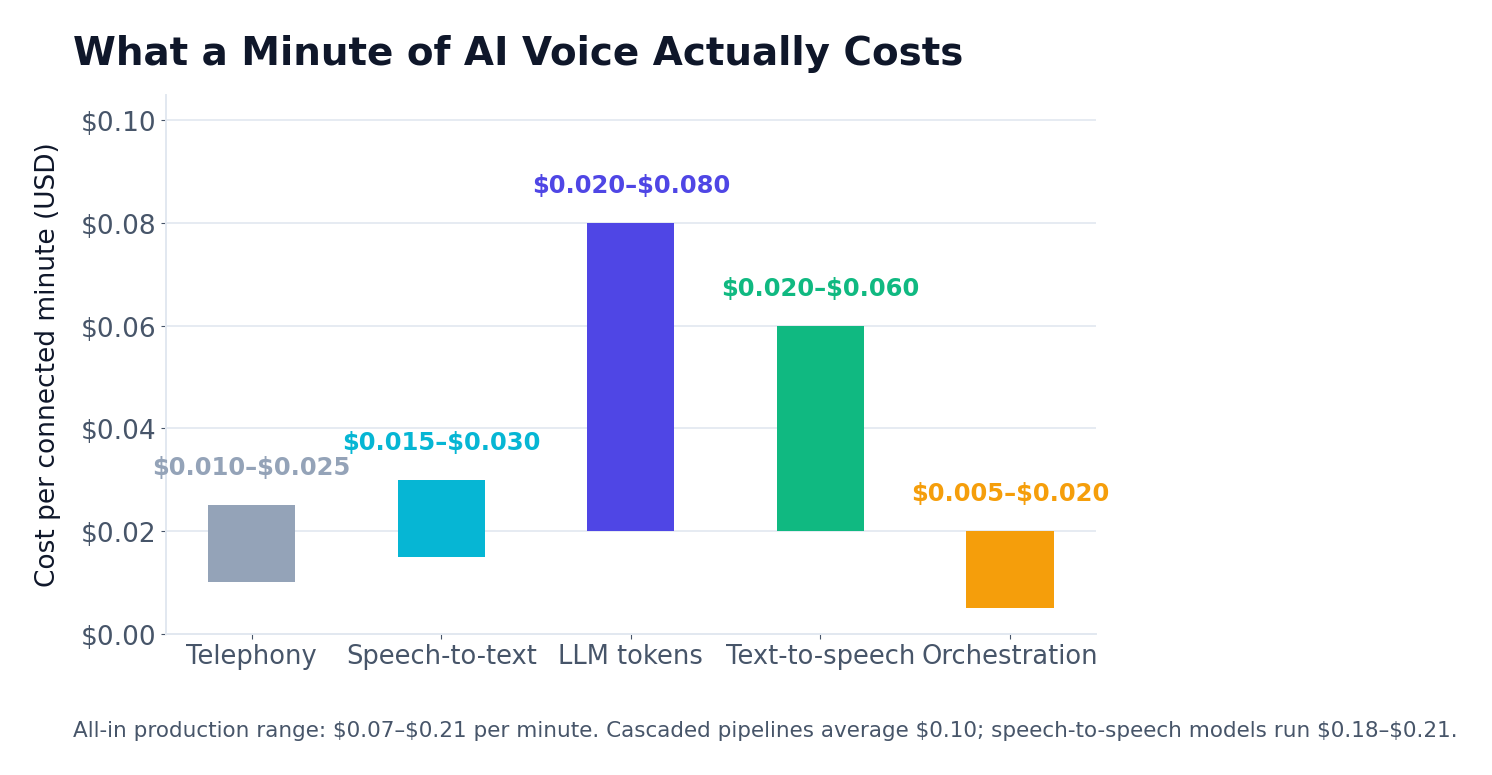
So how much does a voice agent cost in practice? At a median $0.10 per minute, a five-minute support call costs roughly fifty cents to resolve — against a fully loaded human cost that is many multiples higher. Budget separately for implementation: platform subscriptions commonly run a few hundred dollars a month, and integration, prompt engineering and call-flow tuning are one-time costs that typically dwarf the first year of usage fees. Model the total, not the minute rate.
How to Choose an AI Voice Agent Platform
What to look for in an AI voice agent vendor depends entirely on the shape of your operation. The market for conversational AI platforms and conversational AI tools divides roughly into developer-first infrastructure (Vapi, Retell, LiveKit), voice-model specialists (ElevenLabs, Deepgram), telephony incumbents adding AI layers (Twilio, Nextiva), and full-service agencies that build and operate the agent for you. The right answer depends far less on feature checklists than on who will own the thing after launch.
Evaluate against these criteria, in roughly this order of importance:
- Integration depth. Does it connect to your actual CRM, calendar and helpdesk — natively, not “via webhook, with development”?
- Measured latency. Ask for p50 and p95 figures on your telephony route, not a marketing number.
- Interruption handling. Test barge-in on a live call before you sign anything. It is the fastest way to separate a real product from a demo.
- Escalation quality. How cleanly does it transfer to a human, and does context travel with the call?
- Observability. Transcripts, recordings, containment reporting and failure analysis should be built in.
- Compliance posture. SOC 2, HIPAA or GDPR as your sector requires — verified, not asserted.
- Pricing transparency. Insist on all-in per-minute costs including telephony and model usage.
Which AI voice agent is best for small businesses? Almost always a managed platform or an implementation partner rather than developer infrastructure — the build cost of a DIY agent rarely justifies itself below significant call volume. Enterprises with in-house engineering and strict data-residency requirements should weigh the opposite trade-off. In every case, run a scoped pilot on one call type, measure containment and caller satisfaction against your existing baseline, and expand only from evidence.
Frequently Asked Questions
What is conversational AI?
Conversational AI is any technology that enables a machine to hold a natural dialogue with a person, in text or speech. It combines natural language understanding, dialogue management and response generation, and it powers everything from website chatbots to the AI voice agents that answer business phone lines.
How does conversational AI differ from basic chatbots?
A basic chatbot follows a scripted decision tree and fails outside it. Modern conversational AI uses a large language model to interpret meaning, retain context across a whole conversation, and call external systems to complete tasks. The practical difference is that one answers questions while the other finishes work.
Does an AI voice agent improve appointment booking rates?
Yes, primarily by eliminating missed calls. Voice agents answer every call instantly, including after hours and during peak periods when lines would otherwise go unanswered, and they run automated confirmation and reminder sequences. Practices commonly report meaningful reductions in no-shows once reminder calls are automated.
Can you integrate conversational AI voice bots with existing systems?
Yes. Integration is the point. Voice agents connect to CRMs, calendars, EHRs, helpdesks and databases through APIs and function calling, which is how they book, look up and update records mid-call. Systems without a usable API require middleware, and that work should be scoped before you commit.
Is ChatGPT conversational AI?
Yes. ChatGPT is a generative model delivered through a conversational interface, so it qualifies as both generative AI and conversational AI. The categories describe different things — one a capability, the other a purpose — and most modern systems, including voice agents, belong to both at once.
How do you reduce AI voice agent interruptions?
Tune endpointing so the agent distinguishes a thinking pause from a finished sentence, enable barge-in so it stops speaking the moment a caller talks, and stream every pipeline stage instead of batching. Keeping the median response under roughly 800 milliseconds removes most perceived interruption problems.
What are AI voice agents for healthcare?
They are voice agents configured for clinical front-office work: booking and rescheduling appointments, confirming visits, handling prescription refill requests, triaging routine questions and answering after-hours calls. Because they touch patient data, they require HIPAA-compliant handling, explicit consent flows and full audit logging from day one.
Does conversational AI improve over time by learning from interactions?
Not automatically. Production agents do not retrain themselves on live calls. Improvement comes from reviewing transcripts, identifying failure patterns, and updating prompts, knowledge sources and call flows deliberately. Treat it as an operational discipline rather than an emergent property of the software.
The Bottom Line
AI voice agents are not chatbots with a microphone bolted on. They are a distinct category defined by real-time constraint, genuine reasoning and the ability to act on your systems — and they are replacing IVR menus considerably faster than most operators expected. The organisations getting value from them are not the ones that bought the most impressive demo; they are the ones that picked a single high-volume call type, measured containment honestly, and expanded from there.
If you would like to hear what one sounds like handling your calls, book a live AI voice agent demo with ScaleMatix — we will map the highest-volume call type in your business and show you exactly what an agent would do with it.