SaaS Marketing Funnel Explained
A practical explanation of SaaS funnel stages, clear exit conditions, conversion calculations and team handoffs, with a fictional worked example.

A SaaS marketing funnel is a practical map of how a potential customer discovers a product, evaluates its fit, becomes a customer and continues receiving value. Its purpose is to show where progress stalls and who can help. A diagram alone cannot tell you why someone did not buy.
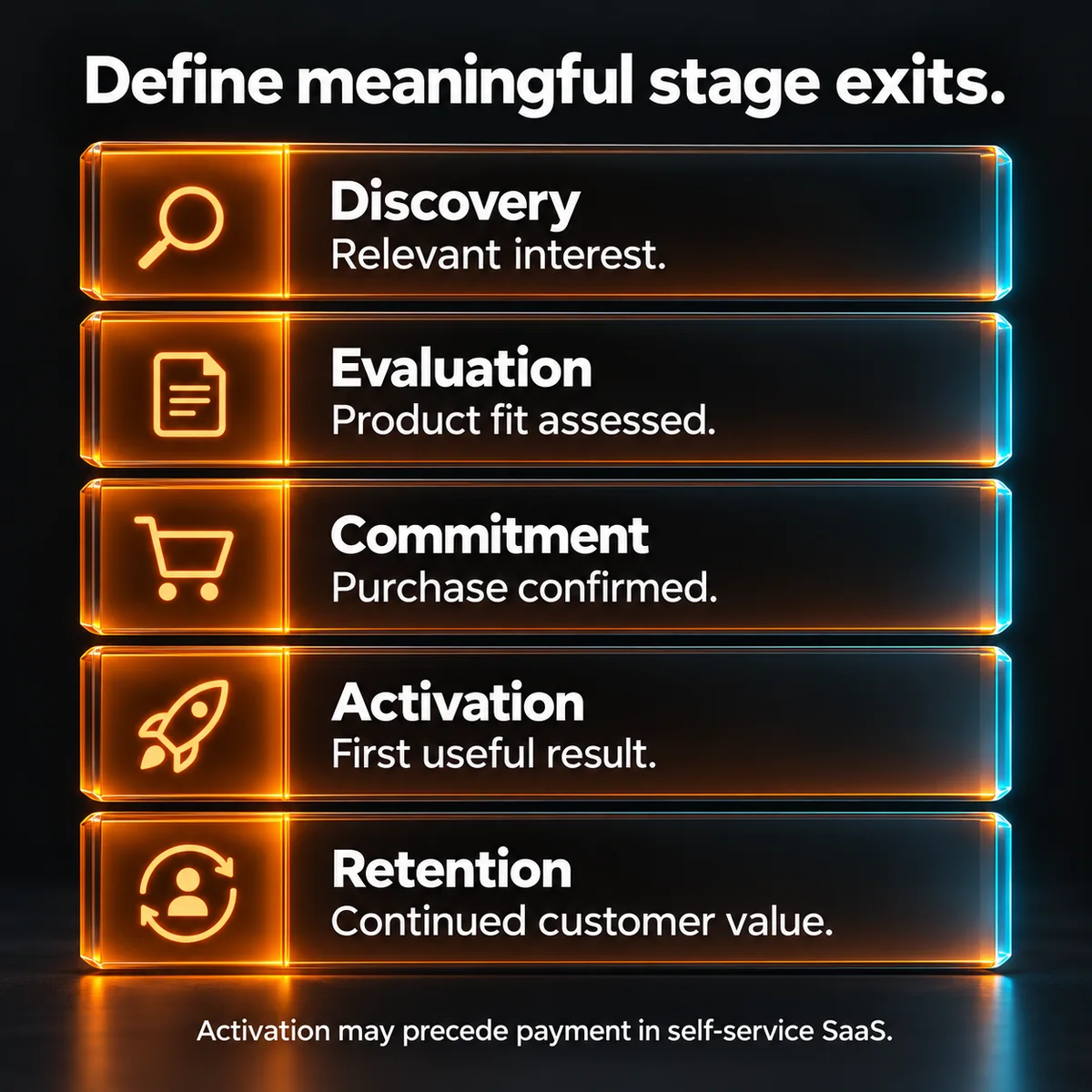
For a useful starting model, follow discovery → evaluation → commitment → activation → retention. Adapt the order and entry points to your product: a self-service user may activate before paying, while an enterprise account may sign a contract before implementation begins. This article explains the stages and the measurement rules behind them.
What belongs in a SaaS marketing funnel?
Include the steps that represent meaningful changes in the customer relationship. Reading an article is different from starting an evaluation; creating an account is different from completing a useful workflow. Define those changes in customer terms before choosing the labels your reporting tools will use.
The funnel is a reporting model, not a promise that buyers move neatly from top to bottom. A buying committee may revisit pricing, security and integration questions several times. Existing users can bring a new team into the product. Record the relevant movement without forcing every account through an identical sequence.
Marketing, sales, product and customer success can all contribute. Marketing helps people understand the problem and offer; sales supports a considered buying decision; product and success teams help customers reach value. Assign ownership to the next action rather than assuming every funnel issue belongs to the acquisition team.
Five stages, with clear exit conditions
1. Discovery: attract the right potential customers
The buyer recognizes a relevant problem or discovers a possible solution. Useful content explains the problem, intended audience and practical next step. Examples include a search article, partner introduction or campaign landing page that accurately describes the offer.
An exit condition might be an identifiable expression of interest, such as a relevant demo request or an eligible signup. Website visits are useful context, but anonymous traffic alone does not establish commercial fit. Keep reach and qualified progression separate in reporting.
2. Evaluation: help the buyer assess fit
The prospect tests whether the product can solve the intended problem under real constraints. They may need a guided demonstration, trial, integration information, security documentation or a discussion about implementation. Match the route to what the buyer needs to learn.
Define what counts as a genuine evaluation. A booked demo that nobody attends should not count as a completed evaluation. A trial account opened by an employee should not count as a prospective customer. Document exclusions so teams do not interpret the same total differently.
3. Commitment: record the buying decision
Commitment is the agreed commercial step: a paid subscription, signed order or other defined purchase event. It should be supported by a reliable billing or CRM record. A positive sales conversation is progress, but it is not the same event as becoming a customer.
For sales-assisted products, decide how a qualified opportunity differs from an interested contact. HubSpot’s lifecycle documentation distinguishes marketing-qualified leads, sales-qualified leads, opportunities and customers, while allowing customized stages. Those labels provide one implementation example; your own exit rules must fit your buying process.
4. Activation: help the customer reach a useful first result
Activation is a product-specific milestone that indicates initial value. For reporting software, it might be connecting an appropriate data source and producing a report the intended user can use. Logging in or viewing a welcome screen may be necessary, but neither automatically demonstrates a useful outcome.
A free trial can put activation before commitment. A product requiring procurement and deployment can put commitment first. Track the two separately in either model. This helps you distinguish an evaluation problem from a setup or adoption problem.
5. Retention: support continuing customer value
After the first result, customers must be able to repeat the workflow and benefit from it. Review continued use, account health and renewal outcomes using definitions appropriate to the product. A monthly login is not equally meaningful for a daily collaboration tool and quarterly planning software.
Keep expansion separate from retention when reporting. A larger contract with one account does not mean that every acquired customer stayed. Marketing can support education and adoption, but product capability, reliability, implementation and support also affect the relationship.
How to measure stage conversion correctly
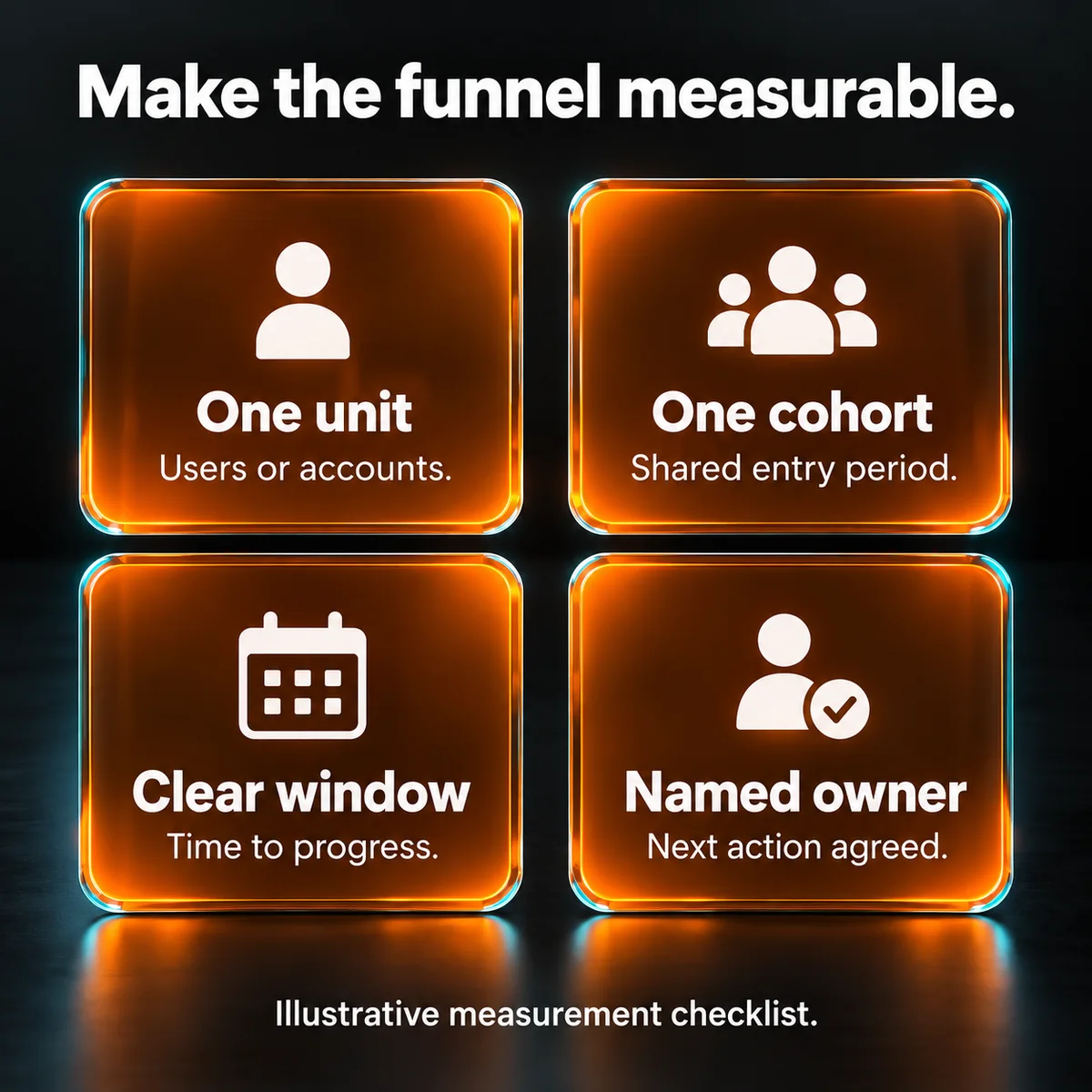
For a defined cohort, stage conversion rate = eligible accounts reaching the next stage within the observation window ÷ eligible accounts entering the starting stage × 100. State the account definition, qualifying events, dates, exclusions and time window beside the number.
Use the same unit throughout the calculation. If three employees from one company start trials, decide whether your question concerns three users or one account. Do not divide paid accounts by trial users and present the result as account conversion. Deduplicate consistently and explain identity gaps.
Amplitude’s funnel analysis documentation shows why event order and included users matter: analysis depends on the specified events, ordering rules and segment. Apply that discipline even if you review the funnel in a spreadsheet rather than a product analytics tool.
A calendar-month total is not always a conversion cohort. Customers who paid in June may have started evaluating in April. Dividing June purchases by June trial starts mixes different groups unless you explicitly intend a period-flow ratio. Give a trial cohort enough time to complete its purchase window before comparing it with a mature cohort.
A worked example: finding the next question
Imagine 100 eligible business accounts begin a self-service trial during one week. Within the following 30 days, 40 reach the defined activation milestone and 20 begin paying. These are fictional numbers for explaining the calculation, not industry benchmarks or Scalematix client results.
Activation among trial accounts is 40 ÷ 100 × 100 = 40%. Trial-to-paid conversion is 20 ÷ 100 × 100 = 20%. You cannot conclude that half of activated accounts paid without checking whether those same 20 paying accounts are within the activated group. The overlap needs its own measurement.
The next investigation is specific: did eligible accounts fail to connect their data, misunderstand the workflow, encounter missing functionality or simply lack a current need? Review the relevant event paths and customer feedback. A lower rate identifies a question; it does not establish the cause or prove that a redesign will improve it.
Choose a useful handoff, not another ambiguous label
For each transition, record four items: the evidence that the account is ready, the receiving owner, the next action and the expected response window. For example, a prospect with an identified use case and implementation question may need a named sales owner and a tailored evaluation plan.
Provide context with the handoff: intended workflow, participants, constraints, previous conversations and open questions. Agree on what happens if the account is unsuitable or not ready. A shared queue without ownership can hide stalled evaluations even when lead volume appears healthy.
Keep contact-level and account-level states visible. One enthusiastic user does not mean procurement has approved the purchase. Likewise, a company-level opportunity does not show whether the intended users have completed a useful evaluation. Connect these views without pretending they are interchangeable.
Run a short funnel review before adding more traffic
Start with one customer segment and one evaluation route. Confirm that the events and records are trustworthy, then review stage counts, conversion, time in stage and customer feedback together. Split comparisons by meaningful differences such as self-service versus sales-assisted evaluation when volume allows.
Prioritize a bottleneck where you have both a clear customer problem and a feasible action. If prospects cannot understand the offer, clarify it. If setup is failing, investigate setup. If buyers cannot justify the purchase, improve the evaluation evidence. Record the expected change and review customer and commercial outcomes afterward.
For the wider lifecycle context, read the complete SaaS marketing guide. If your teams need a shared view of where growth is stalling, explore Scalematix’s growth strategy consulting or send a brief about your SaaS funnel. Start with a clearly defined transition and a question the evidence can answer.
Let’s make
your next move.
LET’S TALK
Bring your ambition.
We’ll bring a different perspective.