AI Search Visibility: How to Get Your Business Cited by ChatGPT, Gemini and AI Overviews
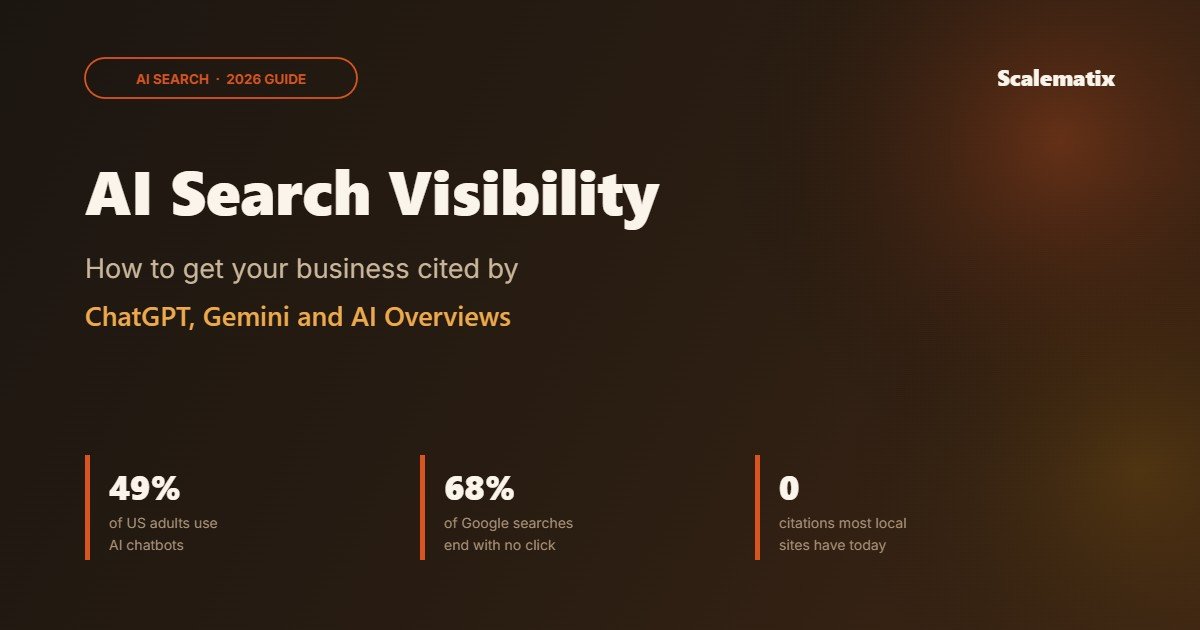
49% of US adults now use AI chatbots and 68% of Google searches end without a click. Here is how to make ChatGPT, Gemini and AI Overviews cite your business.
AI search visibility is whether AI assistants name your business when someone asks them for a recommendation. It is not a ranking position. There is no page two. Either ChatGPT, Gemini, Perplexity or a Google AI Overview says your name, or it says a competitor’s — and the customer never sees a list to choose from.
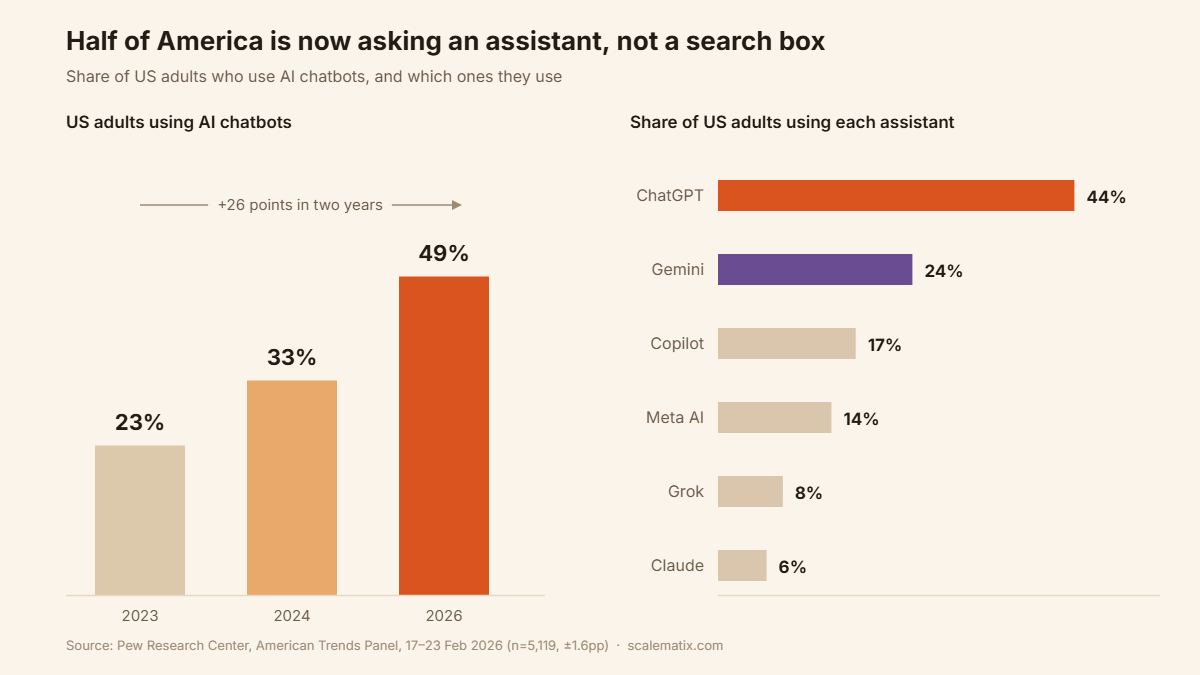
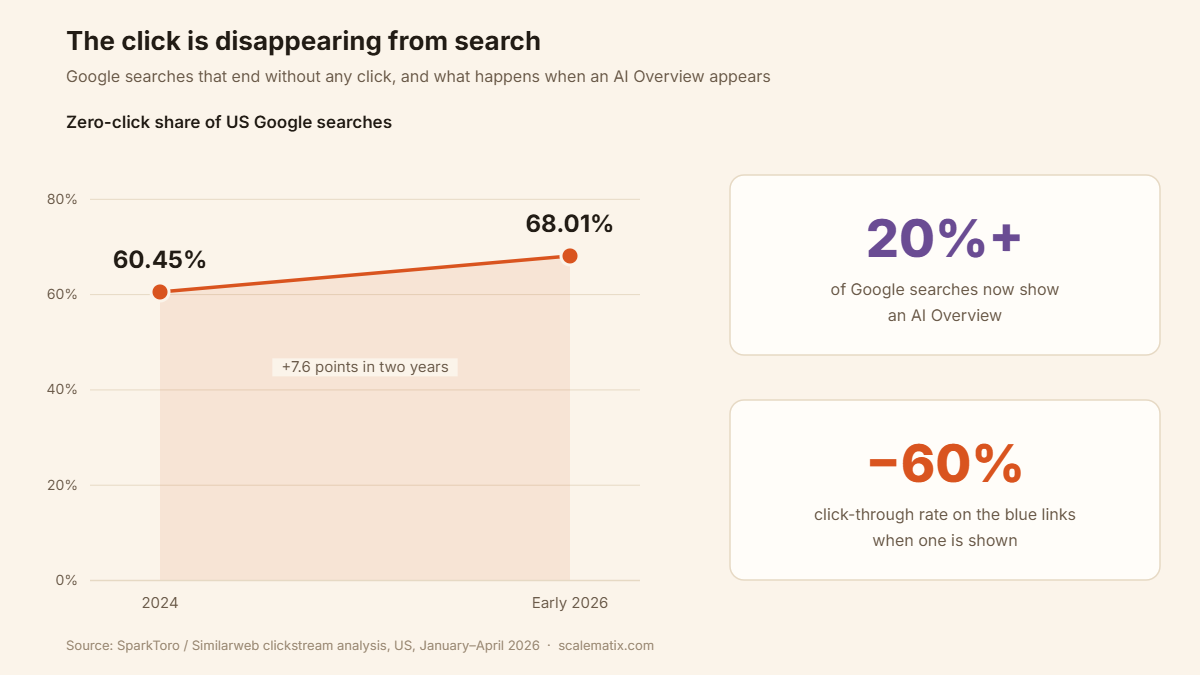
That distinction matters more every quarter. In February 2026, Pew Research Center found that 49% of US adults now use AI chatbots, up from 23% in 2023. Nearly a quarter use one every day. Meanwhile, SparkToro’s clickstream analysis with Similarweb found that 68% of US Google searches now end without a single click to any website.
Put those two numbers together and the picture is uncomfortable: more people are asking, and fewer of them are clicking through to find out. The answer is delivered inside the interface. If your business is not part of that answer, the enquiry never happens — and unlike a bad Google ranking, you get no impressions report telling you it went wrong.
What AI search visibility actually means
Traditional SEO measures position: you rank third for a phrase, you get roughly a known share of the clicks. AI visibility measures inclusion. When someone types “best emergency plumber in Tulsa” into ChatGPT, the model returns a short list — usually three to five names — assembled from what it has read about businesses in that category and that area.
There are three things worth understanding about that list.
It is short. A Google results page shows ten organic listings plus a map pack. An AI answer shows three to five. The drop-off from position five to position six is not a decline in traffic; it is zero.
It is assembled, not retrieved. The model is not reading a ranked index. It pulls from what it absorbed in training, what it fetches live, and what its retrieval layer surfaces from sources it trusts. You need to be present and consistent across all three.
It is invisible to your analytics. When a model reads your page and recommends you without the user clicking, nothing appears in Google Analytics. The referral only shows up if the person clicks the citation — and most do not. Your AI visibility can be growing or collapsing right now and your dashboard would look identical.
AEO vs GEO vs SEO: the terms, settled
Three acronyms describe overlapping work, and the industry has not agreed on clean boundaries. Here is the practical version.
Answer Engine Optimization (AEO)
AEO is optimizing to be the source of a direct answer — a featured snippet, a voice assistant response, an AI Overview. The unit of optimization is the question-and-answer pair. If someone asks “how much does an AI receptionist cost,” AEO is the work that makes your paragraph the one that gets read aloud or lifted into the summary box.
Generative Engine Optimization (GEO)
GEO is optimizing to be cited inside content that a large language model generates from scratch. The unit is the citation. It is less about matching one question and more about being the kind of source a model reaches for when it composes an answer: specific, current, structured, corroborated elsewhere.
One warning if you research this term: “GEO” also means geographic. A meaningful chunk of search volume for “GEO optimization” is people looking for local SEO, not generative engines. Do not let that noise distort your keyword planning.
Does this replace SEO?
No, and anyone selling it as a replacement is selling you something. Every major AI assistant leans on a conventional search index somewhere in its pipeline — ChatGPT’s browsing uses Bing, Google’s AI Overviews are built on Google’s own index, Perplexity runs its own crawler alongside third-party results. A site that cannot be crawled, is slow, or has no authority does not become visible to AI by adding schema markup.
The honest framing is that AEO and GEO are a layer on top of technical SEO, not an alternative to it. What changes is the target: you are no longer optimizing purely for a human scanning ten blue links, you are also optimizing for a machine deciding which three sources to trust.
How AI assistants actually pick who to cite
Nobody outside these companies has the ranking algorithm. But the patterns are consistent enough across models to work from, and they come down to four things.
Extractability. Can the model find a clean, self-contained answer on your page? Content that buries its conclusion under six paragraphs of preamble is content a model will skip in favor of a page that answers in the first line.
Specificity. Models favor sources that commit to details. “Pricing varies depending on your needs” is unusable. “$300–$800 per month for a single-location practice, plus a $500 setup fee” is quotable, and quotable content gets quoted.
Corroboration. A claim that appears only on your own website is weak. The same fact repeated across your site, your Google Business Profile, a directory listing, a review site and a forum thread reads as verified.
Consistency of identity. Models build an internal picture of your business as an entity. If your company name, address, phone number and service description differ across the web, that picture is blurry, and a blurry entity does not get recommended with confidence.
Why a small site can outrank a big one here
This is the part worth paying attention to if you run a five-person business. Domain authority matters far less in AI citation than it does in Google’s blue links. Models are not primarily ranking by backlink count — they are looking for the passage that best answers the question.
A single-location dental practice with a page stating its hours, prices, insurance networks and the questions patients actually ask can get cited ahead of a national directory with a hundred times the authority — because the directory’s page is generic and the practice’s page is not.
That opening will not last. Right now most local businesses have published nothing a model can use.
The 7-step AI search visibility framework
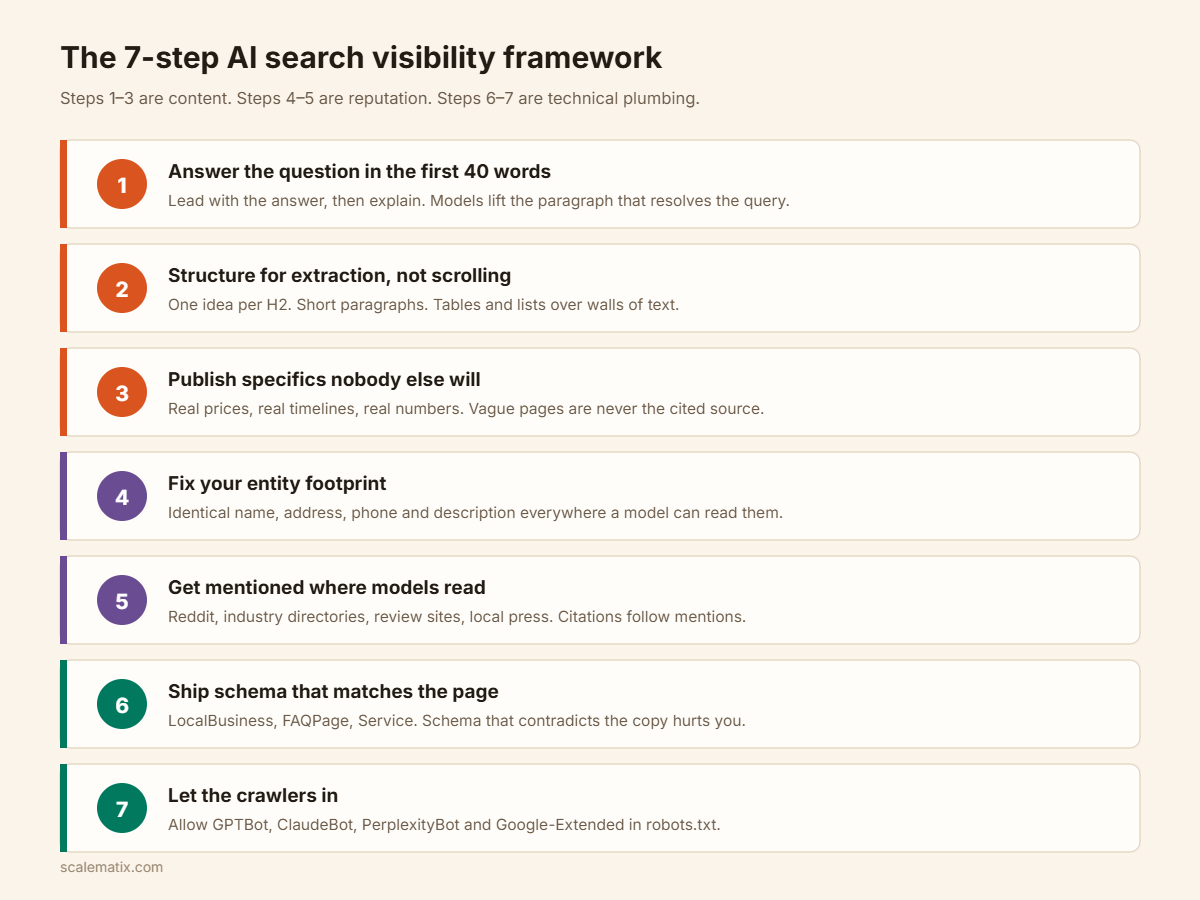
Work through these in order. The first three are content, the next two are reputation, the last two are technical plumbing.
1. Answer the question in the first 40 words
Every page should open with a direct, complete answer to the question it targets, before any context or story. Then explain underneath. This single change does more for AI visibility than anything else on this list, because it gives the model a clean block to lift.
A simple test: delete everything on the page except the first paragraph. Does what remains answer the question? If not, rewrite it.
2. Structure for extraction, not scrolling
One idea per H2. Short paragraphs. Comparison tables instead of prose comparisons. Numbered steps instead of narrative sequences. A model parsing your page is looking for boundaries it can trust — headings that genuinely introduce the content beneath them, lists that are genuinely parallel.
Avoid the pattern of a heading followed by three paragraphs that wander into a different subject. That teaches the parser that your headings are unreliable.
3. Publish the specifics nobody else will
Prices. Timelines. Response times. Service area boundaries. Which insurers you accept. What you do not do. Most business sites avoid all of this out of a fear of being pinned down, and the result is a page that is functionally invisible to an answer engine.
If you are unwilling to publish a number, publish a range and the factors that move it. That is still specific. “It depends, contact us” is not.
4. Fix your entity footprint
Your business name, address, phone number and category must be byte-identical everywhere: your site footer, Google Business Profile, Apple Business Connect, Bing Places, Yelp, industry directories, your Facebook page. “St.” on one and “Street” on another is a small inconsistency that adds up across dozens of sources.
Add an About page that states plainly what the business is, where it operates, when it was founded and who runs it. Models use pages like this to resolve entity questions.
5. Get mentioned where models actually read
Citations follow mentions. The sources that carry disproportionate weight are the ones with high-trust, high-freshness signals: Reddit threads in relevant subreddits, established industry directories, local news, review platforms, and question-and-answer sites.
This does not mean spamming Reddit — models and moderators both punish that. It means being genuinely present where people in your market ask questions, under your real name.
6. Ship schema that matches the page
Structured data helps a parser confirm what it already inferred from your copy. For a local business the useful types are LocalBusiness (or its specific subtype, like Dentist or Plumber), FAQPage, Service and Review.
One rule: schema must match the visible page. Marking up prices you do not display, or FAQs that do not appear on screen, is a reliable way to get the whole page discounted.
7. Let the crawlers in
Check your robots.txt. Many sites are blocking the exact crawlers they need. If you want to be cited, allow GPTBot and OAI-SearchBot (OpenAI), ClaudeBot (Anthropic), PerplexityBot, and Google-Extended.
This is a real trade-off: allowing these crawlers means your content feeds training and retrieval, and some publishers reasonably decline. For a local service business trying to be found, the calculation is simple — you cannot be cited by a system that is not allowed to read you.
What this looks like for a local business
The advice above gets written for SaaS companies and national brands. Here is the local translation, which is where most of our automation work starts.
Your Google Business Profile is a primary source, not a formality. Complete every field. Use the Q&A section deliberately — post the questions customers actually ask and answer them properly. That section is public, structured, and read.
Reviews are training data. The language in your reviews teaches models what you do. A hundred reviews saying “same-day emergency callout” builds an association that no amount of homepage copy will. This is one more reason to automate review requests rather than hope for them.
Build one page per service per location. Not a single “Services” page listing twelve things. A page for “emergency AC repair in Round Rock” that answers what it costs, how fast you get there and what hours you cover.
Answer the objection questions. “Do you charge a callout fee?” “Are you licensed and insured?” “What happens if it breaks again?” These are exactly the questions people put to an assistant, and almost nobody has published clean answers.
Then make sure you can answer the phone. AI visibility that generates calls you miss is an expensive way to fund your competitors — which is why we usually pair this work with an AI receptionist that answers around the clock.
How to measure AI search visibility
Standard analytics will not show you this. Three levels, in order of cost.
Manual prompt testing (free). Write down the fifteen questions a customer would ask an assistant before hiring you. Run them in ChatGPT, Gemini, Perplexity and Google AI Mode, logged out, once a month. Record whether you were named, who else was, and what the model said about you. This is unglamorous and genuinely informative — most businesses discover the model is confidently wrong about their hours or services.
Referral tracking (free). In Google Analytics 4, segment referral traffic from chatgpt.com, perplexity.ai, gemini.google.com and copilot.microsoft.com. The volume will be small. Watch the conversion rate instead — AI referrals typically arrive further along in the decision than search traffic, because the model has already done the comparison.
Dedicated tracking tools (paid). A category of AI visibility trackers now runs prompt sets against multiple models on a schedule and reports your share of mentions against competitors. Useful once you have a baseline worth defending; premature before you have done the seven steps.
Where the opportunity actually sits
We pulled the full US keyword set for this topic in Semrush. The head terms are brutally competitive — “generative engine optimization” gets 8,100 searches a month at a keyword difficulty of 77, and “answer engine optimization” 4,400 at 64. Both are owned by the major SEO platforms.
But the long tail is wide open. “AI search visibility” runs 1,000 searches a month at difficulty 32 with a $19.89 cost-per-click. “AI local SEO” sits at difficulty 24. “ChatGPT ranking factors” is at 8. These are questions with real commercial intent and almost no competent competition.
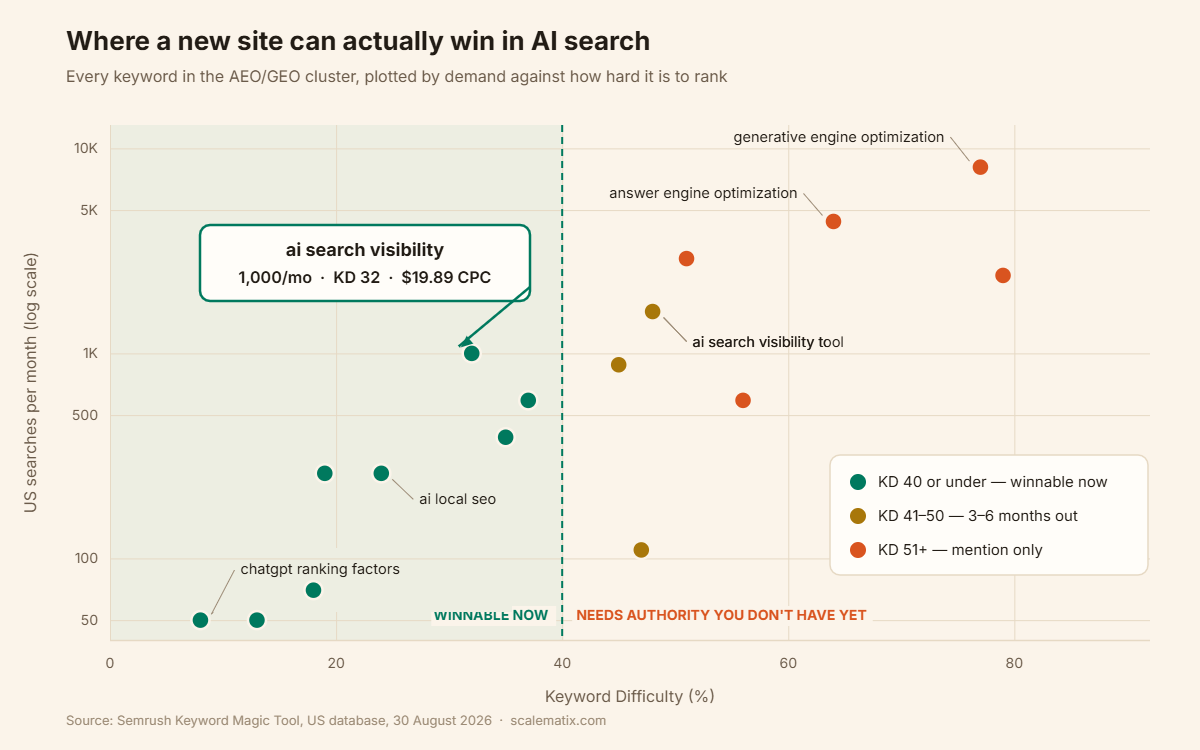
The same asymmetry applies to your business. The competitive terms are contested. The specific questions your customers actually ask are not.
Frequently asked questions
Is answer engine optimization worth it for a small business?
Yes, and disproportionately so, because the bar is currently low. Most local competitors have published nothing an assistant can use. The work overlaps almost entirely with good SEO and good customer communication, so it is rarely wasted even if AI search plateaus.
Does answer engine optimization replace SEO?
No. AI assistants sit on top of conventional search infrastructure. Technical health, crawlability and authority still gate everything. AEO changes what you optimize your content for, not whether you need the foundations.
How long does it take to show up in AI answers?
Faster than Google rankings, in our experience — weeks rather than months for live-retrieval systems like Perplexity and ChatGPT browsing, because they fetch current pages rather than waiting on a training cycle. Baked-in training knowledge takes far longer and is outside your control.
Can I pay to appear in ChatGPT results?
Not in the organic recommendations, no. Anyone offering guaranteed placement in AI answers is describing something that does not currently exist as an advertising product. Treat that pitch as a warning sign.
What if the AI says something wrong about my business?
Correct it at the source rather than arguing with the model. Update your website, Google Business Profile and the major directories, and the correction propagates as retrieval systems re-fetch. Persistent errors usually trace back to one stale listing you forgot about.
Where to start
If you do nothing else this month, do three things: run your fifteen customer questions through ChatGPT and write down what it says about you; add a direct answer to the top of your five most important pages; and check that your robots.txt is not blocking the crawlers you need.
That is a couple of hours of work and it will tell you more about your position than any report will.
Half of American adults are now asking an assistant instead of a search box, and two-thirds of Google searches end without a click. The businesses that get named in those answers over the next two years will be the ones that published specific, structured, verifiable information while their competitors were still writing “we offer quality service at competitive prices.”
Want to know where you currently stand? Book a strategy call and we will run your customer questions through the major assistants and show you exactly what they say about your business — and about the competitor they recommend instead.
#AI OVERVIEWS#AI SEARCH#AI SEARCH VISIBILITY#ANSWER ENGINE OPTIMIZATION#CHATGPT#GENERATIVE ENGINE OPTIMIZATION#GOOGLE BUSINESS PROFILE#LOCAL SEO
Let’s make
your next move.
LET’S TALK
Bring your ambition.
We’ll bring a different perspective.